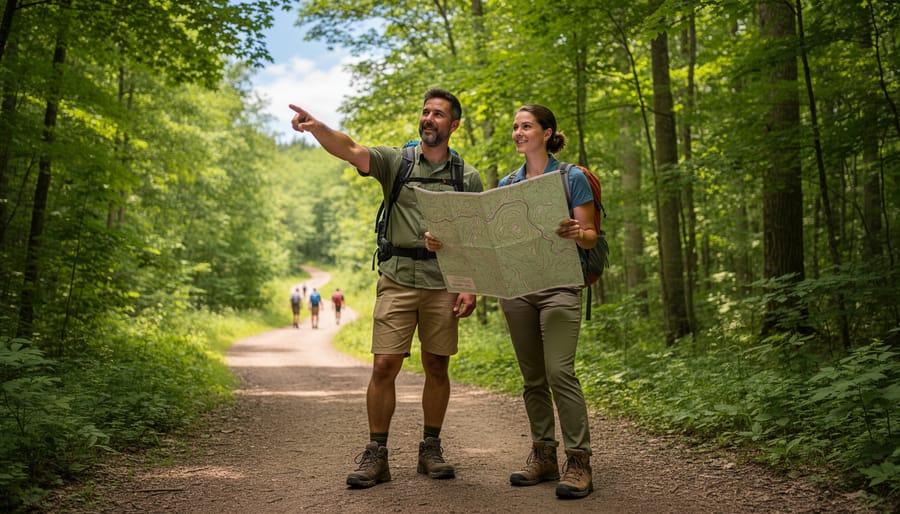
Learning Spanish hiking vocabulary takes about an hour to master the basics, and it instantly opens up trails across Latin America, Spain, and multicultural communities right here in Ontario. Whether you’re planning a trek through the Spanish Pyrenees, connecting with Spanish-speaking hiking groups in Toronto, or simply want to enrich your outdoor vocabulary, knowing terms like “sendero” (trail), “cima” (summit), and “mochila” (backpack) transforms how you experience the outdoors.
The practical benefits go beyond travel. Ontario’s hiking community is beautifully diverse, and you’ll often encounter Spanish speakers on popular routes like the Bruce Trail or Algonquin’s backcountry paths. Being able to share trail conditions, offer directions, or simply exchange a friendly “¿Cómo estuvo la caminata?” (How was your hike?) creates genuine connections that make every outing more memorable.
Here’s what makes hiking vocabulary particularly easy to learn: it’s concrete, visual, and repetitive. You’re not wrestling with abstract concepts. You point to a rock (“roca”), describe the weather (“hace sol” for sunny), or warn about steep sections (“empinado”). The context does half the work for you.
I’ve found that picking up outdoor Spanish also deepens your appreciation for trail culture in Spanish-speaking regions. Understanding why certain paths are called “caminos reales” (royal roads) or recognizing “refugio” signs for mountain huts adds layers of meaning to your adventures. Plus, it’s an eco-friendly way to travel more responsibly, as communicating with local guides and communities helps you follow Leave No Trace principles that are specific to each region.
This guide covers essential hiking vocabulary, pronunciation tips you can practice on your next walk, and strategies for building conversational skills that actually stick when you’re out on the trail.
The Rise of Spanish-Speaking Hikers in Ontario Parks
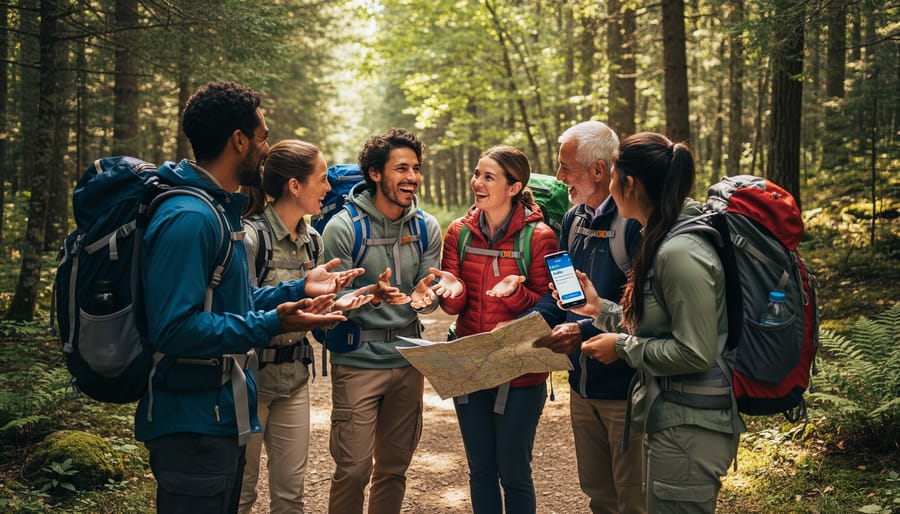
Last summer on the Bruce Trail near Tobermory, I rounded a bend and encountered a family puzzling over a trail marker. “Perdón,” the father began, gesturing toward the blaze. We spent the next ten minutes communicating through a patchwork of broken Spanish, hand signals, and shared laughter about the steep descent ahead. By the time we parted ways, we’d exchanged trail snacks and Instagram handles. That five-minute detour became one of my favourite trail memories of the season.
That encounter isn’t unique anymore. Walk the trails around Algonquin, Killarney, or even smaller conservation areas near Toronto, and you’ll increasingly hear Spanish flowing between hikers. Ontario’s immigration patterns have shifted dramatically over the past decade. Newcomers from Colombia, Mexico, Venezuela, and Spain now make up a substantial portion of our province’s growing population, and they’re discovering our trails in significant numbers.
Many arrive from countries with rich hiking traditions. Spain’s Camino de Santiago pilgrimage routes and the Andes mountain cultures bring deep outdoor heritage. These aren’t tentative first-time hikers, they’re experienced trail enthusiasts looking for new terrain and community. The Spanish language tourism rise reflects broader patterns we’re seeing locally as well.
What makes this shift exciting isn’t just demographic diversity, it’s the opportunity for genuine connection. A simple “buen camino” or “cuidado con las rocas” transforms a passing nod into a moment of recognition. I’ve watched trail regulars light up when they successfully warn Spanish-speaking hikers about muddy sections ahead, and I’ve seen grateful smiles from visitors who finally understand why everyone keeps mentioning “bears” on the trail.
These encounters remind us that trails are natural equalizers. We’re all out there for similar reasons: fresh air, challenge, beauty, escape. Language becomes less barrier and more bridge when you’re both catching your breath at the same lookout, marvelling at the same view.
Essential Hiking Vocabulary: Your Spanish Trail Starter Kit

Trail Greetings and Pleasantries
Start with the easiest wins. A simple “¡Hola!” (OH-lah) works anywhere, though you’ll hear “Buenos días” (BWEH-nohs DEE-ahs) more often in the morning. When passing someone on the trail, “Con permiso” (kohn pehr-MEE-soh), excuse me, shows courtesy on narrow paths.
Want to actually chat? Try “¿Cómo estás?” (KOH-moh ehs-TAHS) for “How are you?” or the friendlier “¿Qué tal?” (keh tahl), which works like “What’s up?” Most Spanish speakers will appreciate even clumsy attempts, so don’t overthink pronunciation.
For trail-specific small talk, memorize these: “¿Cómo está el sendero?” (KOH-moh ehs-TAH ehl sehn-DEH-roh) asks about trail conditions. “¿Es difícil?” (ehs dee-FEE-seel) means “Is it difficult?” When leaving, “Buen camino” (bwehn kah-MEE-noh), good trail, is the hiker’s goodbye you’ll hear across cultures.
The real magic happens when you pair a smile with any of these phrases. Language barriers shrink fast when both people are sweaty, admiring the same view, and trying to communicate. Start with hello, add one question about the trail, and you’ve already made someone’s hike better.
Safety and Navigation Terms
When you’re navigating Ontario’s backcountry, a few key safety phrases can make all the difference. Start with “sendero” (trail) and “marcador” (marker). If you’re discussing difficulty, “difícil” (difficult), “moderado” (moderate), and “fácil” (easy) cover the basics. Distance matters too: “kilómetro” is straightforward, while “¿Cuánto falta?” means “How much farther?”
For backcountry navigation you’ll want “norte/sur/este/oeste” (north/south/east/west) and “perdido” (lost). Weather turns quickly on Ontario trails, so “tormenta” (storm), “niebla” (fog), and “¿Es seguro?” (Is it safe?) are essential.
Safety concerns require direct communication. “Peligro” means danger, while “ayuda” is help. For animal encounters know “oso” (bear), “serpiente” (snake), and “No te muevas” (Don’t move). “Herido” (injured) and “primeros auxilios” (first aid) handle emergencies.
Practice these while hiking alone, and you’ll be ready when you meet Spanish-speaking trail friends who need directions or assistance.
Nature and Wildlife Words
Ontario’s forests and wetlands offer plenty of chances to practice nature vocabulary. Start with the trees: “árbol” for tree, “hoja” for leaf, and “rama” for branch. When you spot wildlife, you might use “pájaro” (bird), “ardilla” (squirrel), or “venado” (deer). Water features are everywhere on Ontario trails, “lago” (lake), “río” (river), “arroyo” (stream), and “cascada” (waterfall) will serve you well.
For terrain, learn “roca” (rock), “colina” (hill), “valle” (valley), and “pantano” (wetland). The words “flor” (flower) and “musgo” (moss) help you describe what you’re seeing underfoot. If you’re hiking near the Great Lakes, “orilla” (shore) and “playa” (beach) become useful.
These aren’t just vocabulary drills, they’re conversation starters. Pointing out a “pájaro carpintero” (woodpecker) or asking if someone’s seen the “cascada” creates natural moments of connection that make both your hike and your language practice more memorable.
Learning Spanish Through Hiking: A Natural Classroom
There’s something beautifully forgiving about learning a language while you’re walking. Your brain is relaxed, your attention shifts naturally between the path and your thoughts, and nobody’s grading you on pronunciation when you’re naming trees under your breath. The trail becomes a low-stakes practice space where mistakes simply dissolve into the forest air.
Start with the simplest technique: narrate what you see. As you walk, try describing your surroundings in Spanish, even if you’re alone. “El cielo está nublado” (the sky is cloudy), “veo un árbol grande” (I see a big tree), “el sendero sube” (the trail goes up). It feels silly at first, but this running commentary builds fluidity faster than flashcards ever could. You’re connecting words directly to experience rather than abstract definitions. When you later need to tell someone the trail is steep, your brain will recall not just the word “empinado” but the burning in your legs when you said it.
Audio lessons pair perfectly with hiking’s natural rhythm. Language learning outdoors engages different cognitive pathways than classroom study, and moderate-pace walking actually enhances retention for many people. Queue up a hiking-focused Spanish podcast or vocabulary app before you hit the trail. The steady movement helps many learners focus better than sitting still, and you can pause to repeat phrases without the self-consciousness of a coffee shop or library.
Hiking with a Spanish-speaking friend or language exchange partner transforms practice into genuine communication. You’re not drilling verbs, you’re solving real problems together: which fork to take, whether those clouds mean rain, how much water is left. The stakes are low but the context is rich. Point to things, use gestures, laugh at mistakes, try again. I’ve watched hikers bond over mispronounced bird names and become trail buddies who meet weekly, half the conversation in English, half in Spanish, all of it relaxed.
Even solo hikers can create accountability by setting small goals: learn five new tree names before the turnaround point, practice weather vocabulary during the descent, greet three other hikers in Spanish. The trail’s structure gives your practice natural milestones and built-in variety. You’re not staring at a screen wondering when the lesson ends. You’re simply walking, noticing, and naming the world around you in a new language.
Making Ontario Trails More Welcoming for Spanish Speakers

You don’t need to wait for official programs or formal initiatives to make a difference. Every time you hike, you can help Spanish-speaking visitors feel more at home on Ontario trails through simple, genuine gestures. Start with a friendly “¡Hola!” when you pass other hikers, and if you notice someone looking uncertain at a trail junction, a quick “¿Necesitas ayuda?” can turn confusion into connection.
Ontario Parks already provides trail information in 14 languages but individual hikers can build on this foundation through everyday actions. Carry a small Spanish-English trail vocabulary card in your pack or save a few key phrases on your phone for quick reference during encounters. When you’re hiking with a group and meet Spanish speakers, slow down and practice your emerging vocabulary together. These moments create memorable experiences for everyone involved.
Consider volunteering with local trail organizations to help translate basic safety information, trail maps, or park brochures. Many conservation areas and hiking clubs welcome this support but lack the resources to pursue it actively. You might also advocate for multilingual trail signage at popular trailheads or work with park staff to identify where Spanish translations would benefit the most visitors.
Share your favorite Ontario trails on Spanish-language social media platforms and community boards, using bilingual descriptions that highlight accessibility, difficulty levels, and seasonal features. When you post trail photos online, include Spanish hashtags and location tags to help Spanish-speaking hikers discover these gems. Building this welcoming environment starts with recognizing that our trails belong to everyone who wants to experience Ontario’s natural beauty, regardless of which language they speak at home.
Resources for Continuing Your Trail Spanish Journey
The best resources for building trail Spanish skills are the ones you’ll actually use between hikes. Skip the formal classroom apps and look for tools built around real conversations and outdoor contexts.
Duolingo and Babbel both offer Spanish courses, but their strength for hikers lies in the short, daily practice sessions you can squeeze in during coffee breaks or commute time. Focus on their conversational modules rather than grammar exercises. For something more immersive, try listening to Coffee Break Spanish podcast during your morning routine or even while hiking solo on familiar trails. The natural pace and practical focus make vocabulary stick better than memorization drills.
Language exchange apps like Tandem and HelloTalk connect you directly with Spanish speakers who want to practice English. Many users share interests in hiking and outdoor activities, creating natural conversation topics. You might even find trail partners for your next Ontario adventure.
Several Ontario communities offer Spanish conversation groups that meet outdoors during warmer months. Check local library boards and community centers, particularly in larger cities with established Latin American populations. Some groups organize walking meetups where you practice Spanish while exploring urban trails and green spaces.
For structured learning with an outdoor angle, look into interactive outdoor programs that occasionally incorporate multilingual elements into nature education. These create perfect low-pressure environments for practicing trail vocabulary in context.
The most effective approach combines several resources: daily app practice for vocabulary building, weekly podcast listening for comprehension, and monthly real-world practice through conversation groups or trail encounters. Start small, stay consistent, and remember that even basic Spanish opens doors to richer trail experiences.
You don’t need to memorize an entire Spanish dictionary before your next hike. Starting with just a handful of phrases transforms your trail experience in ways that surprise you. That simple “buenos días” to a family passing by on the trail, or being able to point out “mira, un ciervo” when you spot deer, creates connections that stay with you long after the hike ends.
The beauty of learning hiking Spanish is how naturally it fits into something you already love. Every trail becomes an opportunity to practice, every encounter a chance to build bridges. You’re not just expanding your vocabulary; you’re actively helping Ontario’s outdoor spaces become more welcoming for everyone who wants to experience them. When Spanish-speaking visitors feel comfortable asking about trail conditions or sharing their excitement about spotting wildlife, we all benefit from richer, more inclusive outdoor communities.
Nature already speaks its own universal language through rustling leaves, bird calls, and the crunch of gravel underfoot. Adding a few Spanish phrases to your hiking repertoire simply amplifies that connection. Start small on your next outing. Try one greeting. Learn the names of trees you pass regularly. Listen more than you speak.
The trails you’ve walked dozens of times suddenly feel new when you’re paying attention to both the landscape and the people moving through it. That’s the real gift of hiking in Spanish: it opens your eyes wider to everything already around you.




+ There are no comments
Add yours