
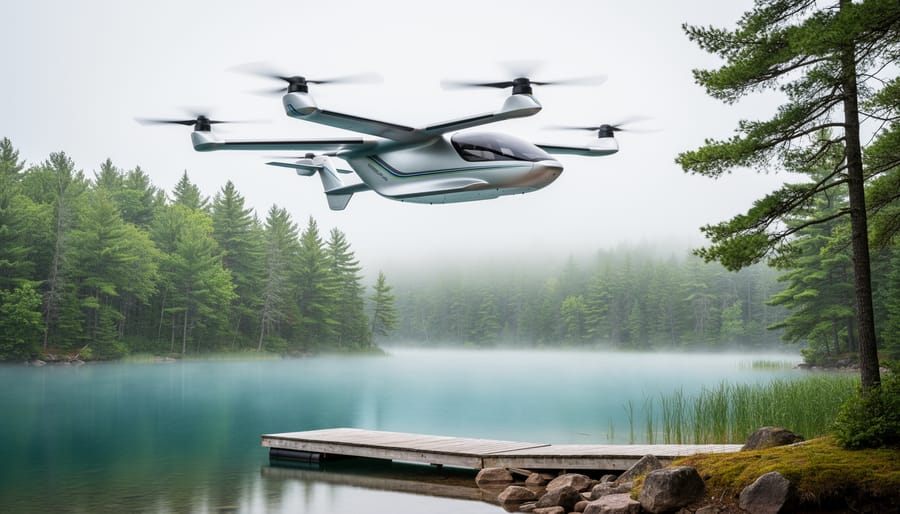
Urban air mobility (UAM) is electric-powered aircraft transport designed to move people and cargo through urban and suburban airspace, bypassing ground-level traffic entirely. Think of it as a sophisticated evolution of helicopter service, using quieter electric vertical takeoff and landing (eVTOL) aircraft that can shuttle passengers from city centers to destinations that would otherwise require long, congested drives.
For Ontario’s outdoor enthusiasts, this technology promises to transform how we access remote parks and wilderness areas. That three-hour slog through cottage-country traffic to reach Algonquin? UAM could cut it to 45 minutes of scenic aerial cruising. Those hard-to-reach provincial parks in Northern Ontario that currently demand full-day road trips might become accessible for weekend adventures.
Right now, UAM is transitioning from prototype testing to early commercial operations. Several aircraft manufacturers are completing certification processes with Transport Canada, and the first passenger routes could launch in Ontario within the next few years. The timeline depends on regulatory approval, infrastructure development, and public acceptance of this new transportation mode.
The potential for park access is genuine but comes with important caveats. UAM won’t replace your car for every trip. Initial routes will likely connect major urban centers to high-demand destinations, and costs will start premium before becoming more accessible. Environmental considerations matter too, especially for a community that values wilderness preservation. The good news? Electric propulsion means zero direct emissions and significantly reduced noise compared to traditional helicopters, making UAM a potentially eco-friendlier option for reaching the natural spaces we love.
This guide walks through what UAM actually involves, how the technology functions, which aircraft types you might encounter, and realistic applications for outdoor recreation in Ontario.
What Urban Air Mobility Actually Means
Urban air mobility isn’t science fiction anymore. It’s a developing transportation system that uses electric aircraft to move people and goods over short distances, typically within cities or between nearby regions. Think of it as taking a taxi, except your ride flies above the traffic instead of sitting in it.
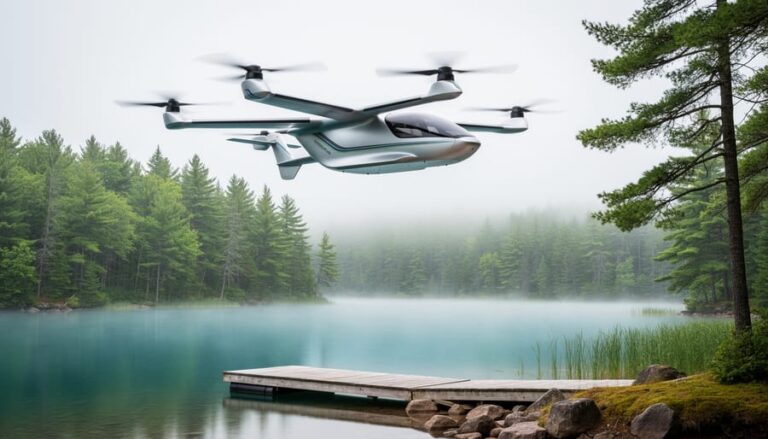
The aircraft at the heart of this technology are called eVTOLs, which stands for electric vertical takeoff and landing vehicles. They lift straight up like a helicopter, transition to forward flight, and land vertically at their destination without needing a runway. Most look like large drones with multiple rotors, though designs vary. What sets them apart from helicopters is their electric propulsion system, which makes them quieter, produces zero direct emissions, and requires less maintenance thanks to fewer moving parts.
- eVTOL
- Electric vertical takeoff and landing aircraft that combines the vertical capability of a helicopter with the efficiency and quiet operation of electric motors. Most designs feature multiple rotors for redundancy and safety.
- Vertiport
- A landing pad and passenger facility designed for eVTOL operations, similar to a helipad but with charging infrastructure and passenger amenities. These can be installed on rooftops, parking structures, or ground-level sites.
- Air Taxi
- A commercial passenger service using eVTOL aircraft for short trips, typically booked through a smartphone app like ride-hailing services. Flights usually carry 2-6 passengers and cover distances of 25-100 kilometres.
- Electric Propulsion
- Battery-powered motors that drive the aircraft’s rotors, replacing traditional combustion engines. This system enables quieter operation, lower operating costs, and zero emissions during flight.
The vision for urban and regional air mobility involves networks of these aircraft operating like aerial bus routes. You’d open an app, book a seat, head to the nearest vertiport (a takeoff and landing pad with passenger facilities), and fly to your destination in a fraction of the time a car would take. The aircraft handles the piloting automatically or with minimal human intervention, and the electric motors make the experience surprisingly quiet compared to helicopters.
For park access, this technology could compress a four-hour drive into a 30-minute flight. Instead of battling highway traffic to reach Algonquin or Killarney, you’d lift off from a vertiport near your home and land at a facility near the park entrance or even at a backcountry access point.
How Urban Air Mobility Systems Work
Urban air mobility systems are designed around simplicity, the whole point is making short flights as easy as booking a rideshare. Here’s how the pieces fit together.
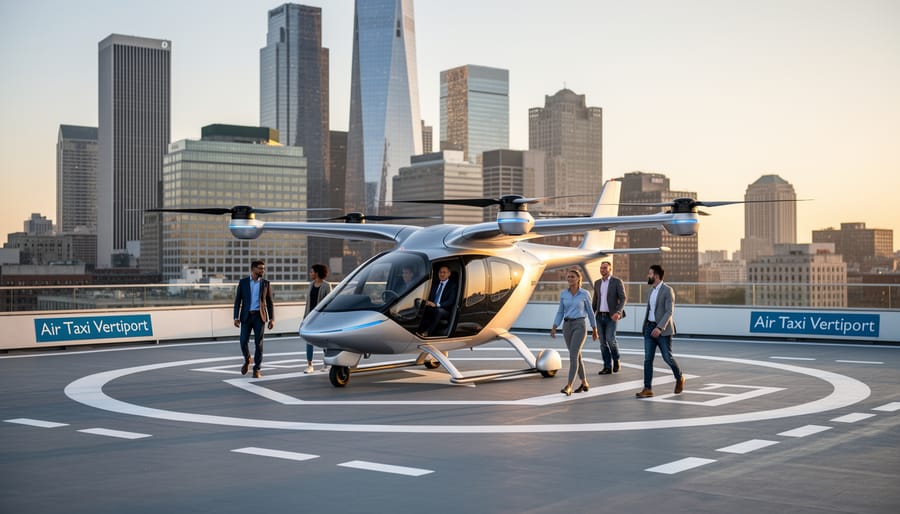
Your journey starts at a vertiport, which is essentially a compact landing pad with a small terminal. Think of it as a helipad meets a bus shelter: a designated takeoff and landing zone with basic passenger facilities, charging infrastructure, and space for a handful of aircraft. Unlike traditional airports sprawling across thousands of acres, vertiports can tuck into urban rooftops, parking lots, or small parcels of land. For Ontario park access, you’d likely see vertiports near major cities and strategically placed near popular parks or trailheads.
Booking works through an app, similar to requesting a ride today. You’d select your destination (say, a vertiport near Killarney Provincial Park), see available flight times, and pay upfront. The aircraft follows pre-approved flight corridors, routes mapped to avoid sensitive areas, minimize noise over communities, and maintain safe separation from other air traffic. Transport Canada would regulate these corridors just as they govern commercial aviation today.
Safety protocols mirror commercial aviation standards but adapted for shorter flights. Pre-flight checks happen automatically through onboard systems, pilots (initially required for all flights) complete visual inspections, and redundant systems ensure the aircraft can land safely even if one component fails. Passenger screening stays minimal, no lengthy security lines, since these flights operate point-to-point rather than through crowded hubs.
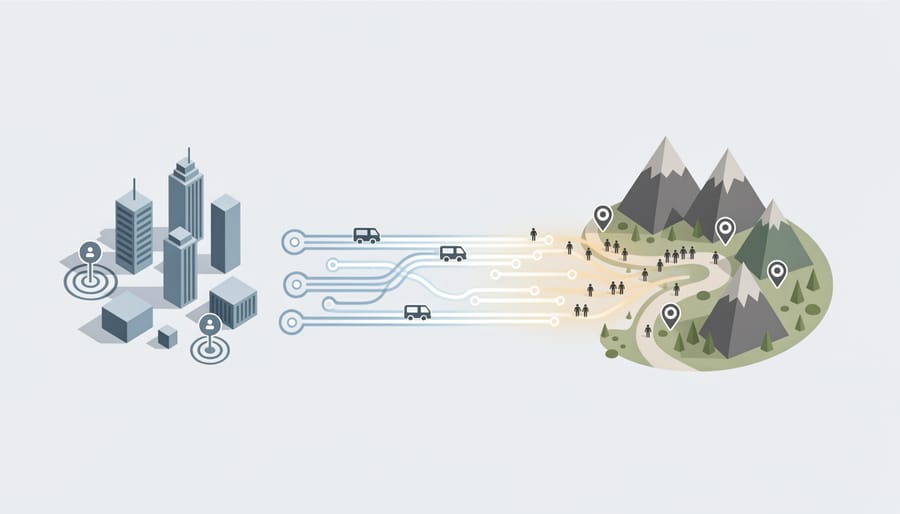
The ground connection matters as much as the flight itself. UAM networks would integrate with existing transport: EV charging stations at vertiports for those driving the first leg, autonomous shuttles ferrying passengers to nearby trailheads, even traditional shuttle vans where needed. The goal is seamless multimodal trips, maybe you drive 30 minutes to a suburban vertiport, fly 45 minutes north, then catch a short shuttle to your campsite. Each segment books through one platform, eliminating the headache of coordinating separate services.
The actual flight experience? Quiet electric motors, large windows, minimal turbulence at low altitudes. Most rides last 15 to 45 minutes for regional trips. You board, buckle in, lift off vertically, transition to forward flight, then descend straight down at your destination. No runways, no taxiing, no circling.
Different Types of Air Mobility Aircraft and Services
Urban air mobility isn’t one-size-fits-all. Different aircraft serve different purposes, and understanding the categories helps clarify which ones might actually show up at an Ontario park someday.
Passenger air taxis are what most people picture when they hear about UAM. These electric aircraft typically seat two to six people plus a pilot (or fly autonomously in some designs). Think of them as flying cars optimized for short hops, most have a range of 25 to 100 miles on a single charge. For park access, this means they’re perfect for trips like Toronto to Algonquin’s east gate (roughly 60 miles) but wouldn’t handle a direct flight to Thunder Bay. They’re designed for quick turnover: land, swap batteries or charge rapidly, and go again.
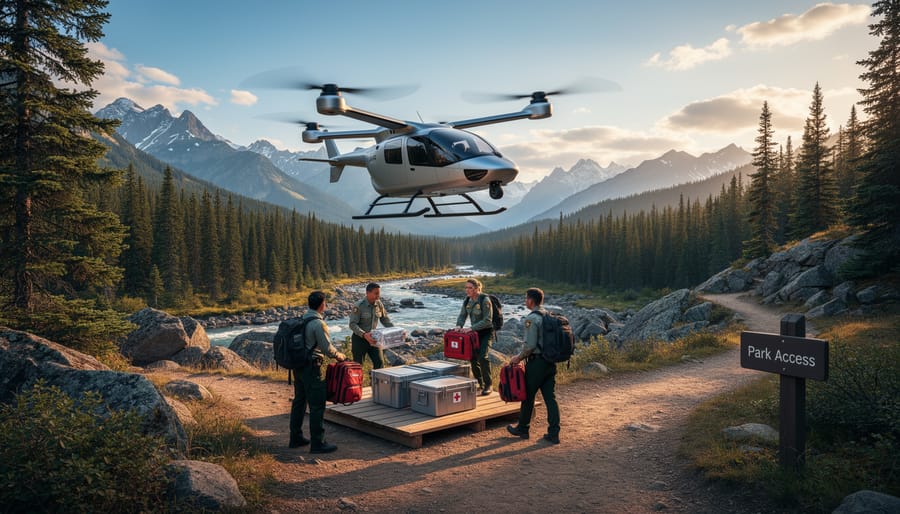
Cargo drones represent the practical side of UAM that outdoor enthusiasts might see first. These uncrewed aircraft can haul camping gear, emergency supplies, or even fresh food to remote lodges and backcountry sites. Payload capacity ranges from 50 to 500 pounds depending on the model, with flight times of 30 minutes to two hours. For provincial parks, cargo drones could resupply trail crews, deliver medical equipment to rangers, or transport your canoe and provisions to a put-in point while you fly in separately.
Hybrid models blur the lines, some switch between passenger and cargo configurations, while others combine electric motors with small combustion engines for extended range. These versatile aircraft might prove most useful in Ontario’s vast geography, where distances between parks can stretch beyond pure-electric capabilities.
For reaching Ontario’s parks specifically, the two-to-four-seat air taxi hits the sweet spot. It matches typical group sizes (couples, small families), covers distances between major cities and popular parks on one charge, and keeps operating costs reasonable enough to compete with long drives.
How Air Mobility Could Connect You to Ontario’s Parks
The Environmental Trade-Offs
Electric aircraft promise a cleaner way to reach parks compared to gas-powered cars, but they’re not a perfect environmental solution. The benefits are real: zero direct emissions during flight, reduced highway congestion, and smaller carbon footprints per passenger-mile on longer routes. If a family from Toronto can fly directly to Algonquin instead of driving three hours, that’s one less vehicle on Highway 60 during peak weekends.
However, wilderness areas face unique challenges. Aircraft noise, even from quieter eVTOLs, can disturb nesting birds during breeding season and disrupt the peaceful experience that draws people to remote parks in the first place. Low-altitude flight paths over sensitive habitats could stress wildlife populations already coping with climate change pressures. Infrastructure matters too: vertiports require cleared land, lighting, and road access for ground connections, potentially fragmenting ecosystems near park boundaries.
Responsible UAM networks can minimize these impacts through smart planning. Flight corridors should avoid critical nesting zones and migration routes, with seasonal restrictions during vulnerable periods (spring breeding, fall migrations). Night flights over wilderness areas might be prohibited entirely. Altitude guidelines can reduce ground-level noise, and approaching vertiports from already-disturbed areas rather than over intact forest makes sense.
Think of it like other low-impact innovations: emergency drones and solar-powered boats offer cleaner alternatives but still require careful deployment. The goal is reducing overall environmental impact while preserving what makes Ontario’s parks special: their wildness and tranquility.
What’s Happening with Air Mobility in Ontario Today
While urban air mobility might sound futuristic, the groundwork is being laid right now across Canada. Transport Canada has been developing regulatory frameworks to safely integrate eVTOL aircraft into our airspace, working alongside aviation authorities worldwide to establish standards for certification, pilot training, and operational procedures.
Several Canadian cities have begun exploring UAM infrastructure possibilities. Planning discussions focus on identifying suitable vertiport locations near transportation hubs, understanding noise impact requirements, and determining how air mobility networks could integrate with existing transit systems. Though these conversations are still in early stages, they represent serious consideration of how this technology might work in Canadian contexts.
Globally, pilot programs in other regions offer valuable lessons. Test flights in urban centres have demonstrated the technology’s viability while highlighting challenges around weather operations, public acceptance, and logistical coordination. These international examples help Canadian planners understand what works and what doesn’t.
For outdoor enthusiasts interested in how UAM might eventually serve park access, staying informed means watching a few key areas. Transport Canada’s website publishes updates on aviation innovation and regulatory developments. Provincial park planning documents occasionally reference future transportation possibilities. Industry associations like the Aerospace Industries Association of Canada track UAM progress and share public reports.
The timeline remains uncertain. Regulatory approval processes are thorough by necessity, infrastructure requires significant investment, and public acceptance takes time to build. Rather than expecting imminent service, think of this as a gradual evolution. The technology is real and advancing, but practical implementation for recreational park access will unfold over years, not months.
Keep your hiking boots ready while staying curious about what’s coming.
Common Questions About Air Mobility and Park Visits
How much would an air taxi to a park actually cost?
Early estimates suggest UAM flights could range from $150-400 per passenger for regional trips once networks scale up, comparable to premium ground transportation options. As the technology matures and operational costs decrease (especially with real charging costs for electric aircraft staying low), prices should drop significantly below today’s helicopter charter rates.
Are these aircraft safe enough for my family?
eVTOL aircraft undergo rigorous Transport Canada certification requiring the same safety standards as commercial airlines, with multiple redundant systems and extensive testing. Many designs include distributed electric propulsion, meaning if one motor fails, others compensate automatically, arguably safer than single-engine helicopters.
What happens if weather turns bad during my flight?
UAM operations will have strict weather minimums and real-time monitoring systems that ground flights when conditions deteriorate, similar to how airlines operate today. Your booking would be rescheduled or refunded rather than risking passenger safety.
Will air taxis disturb the wilderness experience for hikers already in the park?
Electric aircraft produce significantly less noise than helicopters, often compared to highway traffic from a distance, and flight paths can be designed to avoid sensitive wildlife areas and popular backcountry zones. Responsible operators would likely implement seasonal restrictions and designated routes to protect the park experience.
Does this mean I won’t be able to drive to parks anymore?
Not at all. UAM will complement traditional access methods, not replace them, offering an alternative for those with limited time, mobility challenges, or who want to skip long drives during peak season. Your trusty vehicle and the scenic highway route will always remain options.
How would I actually book one of these flights?
The booking process would likely mirror ride-sharing apps: select your destination vertiport, choose departure time, pay through the app, and receive confirmation with check-in details. Expect to arrive 15-20 minutes early for a brief safety orientation, just like catching a water taxi but airborne.
The practicalities matter as much as the vision. Weight restrictions would be similar to small aircraft today, pack light, with soft bags rather than hard-shell luggage working best. You’d bring essential gear while heavier items like canoes could still travel by ground transport or be rented at your destination. Think of it as strategic packing for maximum adventure efficiency.
Urban air mobility represents an exciting frontier for outdoor recreation in Ontario, but it’s important to keep both feet on the ground while looking skyward. The technology shows genuine promise for making remote parks more accessible, reducing travel time, and opening wilderness experiences to people who might otherwise find them out of reach. That said, we’re still in the early stages, regulatory frameworks are being built, infrastructure needs planning, and real-world implementations will take time to roll out.
The beauty of this moment is that you don’t need to wait for flying taxis to enjoy Ontario’s incredible parks. Whether you’re driving up Highway 60 to Algonquin, paddling into Temagami’s backcountry, or hiking the Bruce Trail section by section, these experiences remain as rewarding as ever. And if UAM does become a practical reality in the coming years, it’ll simply add another option to your adventure toolkit, a complement to road trips and canoe routes, not a replacement.
Stay curious about these innovations. Follow Transport Canada’s regulatory updates, watch for pilot projects in other regions, and consider how emerging technologies align with your values around wilderness access and environmental stewardship. The parks aren’t going anywhere, but the ways we reach them might just get more interesting. Keep exploring, however you choose to get there.









+ There are no comments
Add yours