
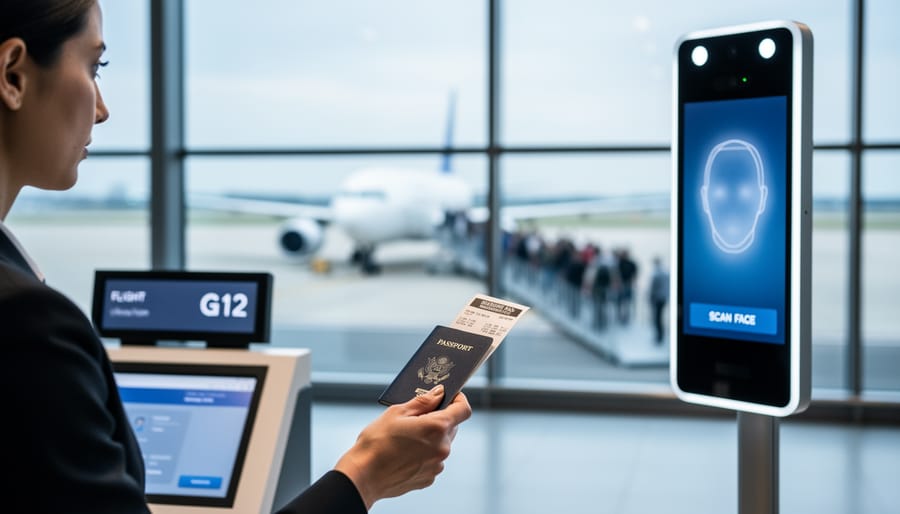
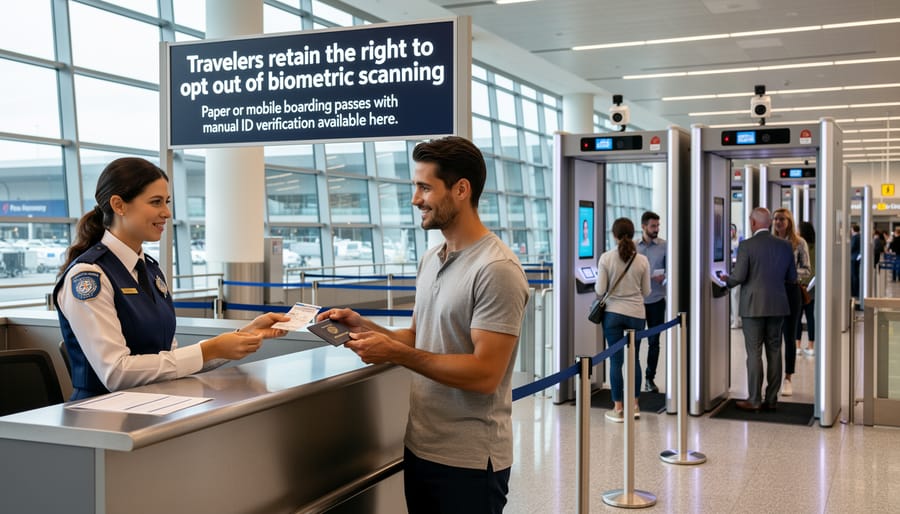
Decline facial recognition at airport boarding gates by informing the gate agent you’re opting out before they direct you to the camera—it’s your legal right, and airlines must provide a manual document check as an alternative. Look for signage near the gate that explains your opt-out option, though it’s often small or poorly positioned, and speak up clearly when the agent instructs passengers to step forward for scanning. Request the traditional boarding pass scan instead, which takes just seconds longer than biometric processing.
While interactive biometric feedback enhances outdoor experiences in Ontario parks by personalizing your adventure, airport facial recognition operates differently—your face scan gets stored in government databases without clear deletion timelines, raising privacy concerns for many Canadian travelers. The technology matches your live image against passport photos to verify identity, a process U.S. Customs and Border Protection and participating airlines have rolled out at major airports including Toronto Pearson for international departures.
You’re not alone in feeling uncertain about this relatively new screening method. Thousands of travelers exercise their opt-out rights monthly, and gate agents are trained to accommodate these requests without delays or complications. Whether you’re heading south for winter sun or returning from exploring Ontario’s wilderness, understanding your options helps you travel confidently while maintaining control over your personal biometric data. The choice is entirely yours, and neither option affects your ability to board your flight.
How Biometric Boarding Actually Works
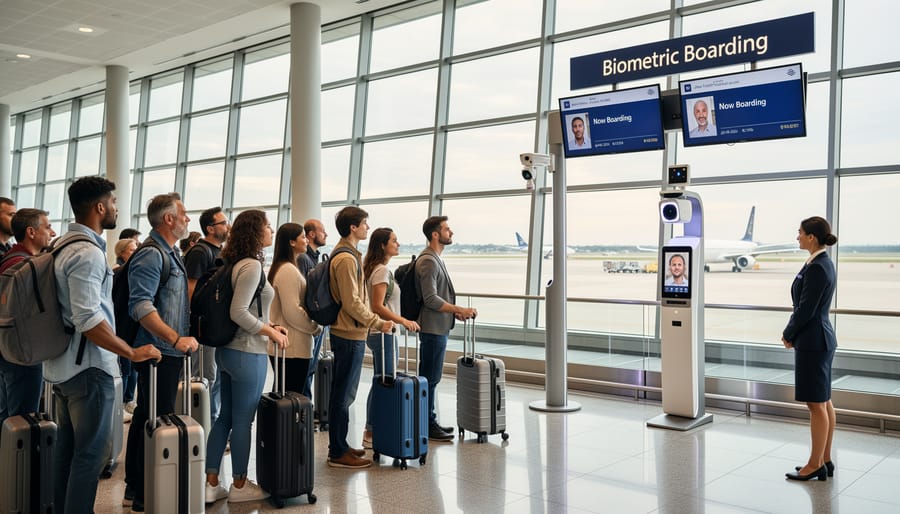
If you’ve traveled through a major U.S. airport recently—perhaps heading home to Ontario after a sunny vacation—you might have noticed camera setups at boarding gates that look a bit like selfie stations. That’s biometric boarding in action, and it’s becoming the new normal at airports across North America.
Here’s how it works in plain terms. When you approach the gate, instead of scanning your boarding pass, you simply look at a camera for a few seconds. The system captures an image of your face and instantly compares it against photos already on file with Customs and Border Protection (CBP). These reference photos typically come from your passport, visa application, or previous entry photos if you’ve traveled internationally before. Within seconds, the system confirms your identity and clears you to board—no fumbling for your phone or paper boarding pass required.
The technology captures your facial geometry during several key moments of your journey:
- At the check-in kiosk when you drop off bags
- During TSA security screening at participating airports
- At the boarding gate before entering the aircraft
- When re-entering the United States through customs and immigration
It’s worth noting that TSA PreCheck biometrics work differently than airline boarding systems. TSA PreCheck uses fingerprints collected during your enrollment appointment specifically for identity verification at security checkpoints. Meanwhile, facial recognition at boarding gates is managed by airlines in partnership with CBP and focuses solely on confirming you’re the ticketed passenger.
The good news? Whether you’re a frequent flyer or someone who just occasionally heads south for adventure, understanding this technology helps you make informed choices about your travel experience.
Your Legal Right to Opt Out (Yes, You Can Say No)
Here’s the good news: biometric boarding is completely voluntary in Canada and the United States. That’s right—you absolutely have the legal right to say no, and no one can force you to participate in facial recognition scanning at the airport.
In Canada, the Personal Information Protection and Electronic Documents Act (PIPEDA) protects your right to control how your biometric data is collected and used. Airlines and airport authorities must offer an alternative boarding process if you choose to opt out. Similarly, in the U.S., the Transportation Security Administration and Customs and Border Protection have consistently stated that biometric screening is optional for American citizens.
I’ll be honest with you—the first time I opted out at Toronto Pearson, I worried it would be a hassle. Would I miss my flight? Would security officers give me a hard time? The reality was much simpler than I’d imagined. The gate agent simply scanned my boarding pass the traditional way, and I was on the plane within minutes. No drama, no delays.
Let’s clear up a common misconception: opting out will not flag you as suspicious or put you on any kind of watch list. You’re simply exercising a legal right, similar to declining a store loyalty card. Airport staff are trained to handle opt-outs routinely, especially at major hubs like Pearson International where Ontario travelers frequently pass through.
Another myth worth busting? That opting out causes significant delays for you or other passengers. In practice, scanning a boarding pass manually takes mere seconds—often no longer than the biometric scan itself. I’ve opted out during busy holiday travel periods and never caused a backup at the gate.
The key is understanding that this technology exists to streamline the boarding process, not replace your rights. Whether you’re heading out for a camping trip in Algonquin or catching an international connection, the choice to participate remains entirely yours.
How to Opt Out Without the Hassle
At Canadian Airports
If you’re flying out of Toronto Pearson, Ottawa International, or other Ontario airports, here’s what you need to know about opting out of biometric boarding. The good news? Canadian airports are generally respectful of passengers who prefer traditional boarding methods.
At Toronto Pearson, you’ll find biometric technology at many gates, especially for international flights. When you approach the gate, simply let the gate agent know you’d prefer not to use facial recognition. They’ll scan your boarding pass manually instead—it takes just a few extra seconds. I’ve done this myself on several occasions, and the process has always been smooth and judgment-free.
Ottawa International follows similar procedures. The staff are typically well-trained on opt-out requests and won’t question your decision. Just speak up before stepping up to the camera.
Here’s an insider tip: arrive at your gate with a bit of extra time if you’re planning to opt out. While the process is quick, having that buffer means you won’t feel rushed or pressured to use the biometric system.
One unique consideration for Ontario travelers: Canada’s privacy laws are generally stronger than in some other countries, giving you clear rights to decline. The airport staff understand this and are prepared to accommodate your choice without hassle.
At U.S. Border Crossings
If you’re an Ontario resident heading south for a weekend getaway or a longer adventure, you’ll encounter a different ballgame at U.S. border crossings. Here’s what you need to know: U.S. Customs and Border Protection has been using biometric collection at land borders since 2020, and the rules differ from what you’d experience at Toronto Pearson or Ottawa International.
At land crossings like Windsor-Detroit or Fort Erie-Buffalo, CBP collects photos of travelers entering the United States. Canadian citizens and permanent residents can request not to have their photos taken, but you’ll need to speak up clearly and politely. The officers may ask why you’re declining, so a simple “I prefer not to participate in biometric collection” usually suffices.
One insider tip: border crossings can be less predictable than airports when it comes to opt-out accommodations. Officers have considerable discretion, and wait times may increase slightly if you opt out. Be patient and respectful throughout the process. Remember, you’re still required to present proper documentation like your passport or enhanced driver’s license.
If you’re planning a camping trip to Michigan’s Upper Peninsula or a shopping excursion to Buffalo, factor in a few extra minutes for potential questions. The good news? Many frequent cross-border travelers report successful opt-outs without major complications once they understand the process.
What Privacy Advocates Want You to Know
Here’s what privacy advocates want Ontario travelers to know before your next flight: your face is unique identifying information, and once it’s captured, you can’t change it like a password.
Privacy experts raise several concerns about facial recognition at airports. First, there’s the question of data retention. While authorities say they delete images quickly, advocates point out that policies can change, and travelers rarely know exactly how long their biometric data is stored or who has access to it. Think of it like leaving your house key with a stranger—you’re trusting they’ll use it responsibly.
Another concern involves potential misuse. Your facial scan could theoretically be matched with other databases without your knowledge. Some travelers worry about creating a surveillance infrastructure that extends beyond airport security. It’s similar to how we’re seeing technology expand in Ontario parks for visitor tracking—convenient, but worth questioning.
Privacy advocates also highlight the lack of transparency. Most travelers don’t realize they’re being scanned until they’re already in line, and many feel pressured to comply rather than cause delays.
On the flip side, supporters argue that biometric boarding enhances security and catches travelers using fraudulent documents. The technology has helped identify individuals on watch lists, and proponents note that traditional boarding passes and passports also create data trails.
The bottom line? Some travelers choose to opt out simply because they prefer controlling who collects their biometric information. Others appreciate the added security layer. Like choosing between a guided tour and exploring Algonquin Park independently, it’s about your personal comfort level with technology and privacy trade-offs. Neither choice is wrong—it’s about making an informed decision that feels right for you.
The Trade-Off: Convenience vs. Privacy
Let’s be real: choosing whether to use biometric boarding comes down to what matters most to you personally. I’ve watched countless travelers breeze through those facial recognition gates while I waited in the traditional line, and yes, it took me an extra three to five minutes. Was it inconvenient? A bit. But here’s what I gained: complete control over my facial data and peace of mind knowing my biometric information wasn’t being stored in yet another database.
- Faster processing time through security and boarding gates, usually 30-60 seconds.
- No need to repeatedly show your boarding pass and ID at multiple checkpoints.
- Reduces physical contact points, which some travelers prefer for hygiene.
- Generally smoother experience during peak travel times at busy airports.
- Your facial scan is stored in government databases, sometimes for extended periods.
- Potential for data breaches exposing your biometric information.
- Limited transparency about who can access your data and when.
- No control over future uses of your biometric template as technology evolves.
Think about your typical airport experience. If you’re heading out from Toronto Pearson for a weekend camping trip in Algonquin and you’ve already budgeted extra time for your journey, those few additional minutes won’t derail your adventure. Many Ontario travelers I’ve spoken with actually appreciate the slower pace, using it as a moment to double-check their gear list or grab that last coffee before their flight. The trade-off isn’t just about time—it’s about aligning your travel choices with your values around personal privacy.
When Opting Out Makes the Most Sense
Opting out particularly makes sense when traveling with children, as many parents prefer controlling how their kids’ biometric data is collected and stored. I’ve chatted with Ontario families heading to Florida theme parks who routinely opt out to maintain consistent privacy standards for the whole family—it keeps things simple and teaches kids about digital boundaries.
If you’re traveling to destinations with stricter privacy protections than North America, like Germany or France, you might want to opt out to align with your destination country’s values. Many European travelers are surprised by how readily biometric scanning happens at Canadian and U.S. airports, and opting out feels more consistent with their expectations.
Personal circumstances matter too. Perhaps you’re dealing with identity theft concerns, work in a sensitive profession, or simply feel uncomfortable with facial recognition technology. There’s no judgment here—your comfort level is valid. Some travelers opt out simply because they prefer traditional document checks and appreciate the human interaction with border agents.
The beauty of having the choice means you can decide what feels right for your situation, whether that’s every trip or just specific journeys where privacy feels especially important.
As you plan your next journey through Ontario’s stunning landscapes and beyond, remember that knowledge truly is power when it comes to protecting your personal information. Understanding your right to opt out of biometric boarding puts you firmly in control of your travel choices, letting you decide what feels right for your privacy comfort level.
Whether you’re heading to explore Algonquin’s trails or catching an international flight for adventure abroad, you now have the tools to navigate airport security with confidence. The beauty of informed travel is that you can focus on what matters most—creating memorable Ontario travel experiences and connecting with nature’s wonders.
Don’t let uncertainty about technology dampen your wanderlust. Simply speak up, ask questions, and politely decline facial recognition when it doesn’t align with your values. Airport staff are there to help, and traditional boarding procedures work just as efficiently. Pack your bags with both excitement and awareness, knowing you’re making mindful choices that protect your privacy while embracing all the incredible travel adventures waiting for you.








+ There are no comments
Add yours