
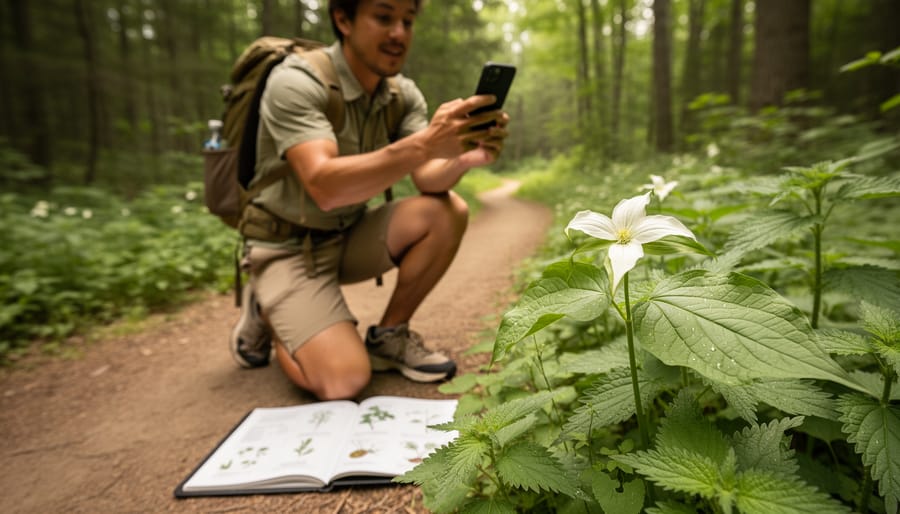
You can confidently identify most plants in Ontario’s parks and trails using a simple four-step process: observe the leaf shape and arrangement, note the habitat and surrounding vegetation, photograph key features from multiple angles, and cross-reference your findings with a reliable field guide or plant identification app. With a bit of practice, this method takes just five to ten minutes per plant and works for everything from wildflowers along the Bruce Trail to towering trees in Algonquin Park.
The skill transforms every hike into a discovery mission. Instead of walking past anonymous greenery, you’ll start recognizing the saw-toothed edges of stinging nettle (and know to give it space), the three-leafed clusters that signal poison ivy, and the delicate white petals of trilliums that carpet the forest floor each spring. Plant identification turns out to be less about memorizing Latin names and more about training your eye to spot patterns, and the learning curve is gentler than most people expect.
What makes this approach practical for beginners is that it doesn’t require a botany degree or expensive equipment. A smartphone camera and a free identification app will get you started, though adding a pocket-sized field guide specific to Ontario flora helps when you’re beyond cell service. The real secret? Starting with common species in familiar places. Your local conservation area probably hosts two dozen easily identifiable plants that will teach you the fundamentals before you tackle rarer specimens or venture into more remote wilderness. Once you’ve nailed the basics, you’ll find yourself noticing details you’ve walked past for years.
What You’ll Need: Essential Tools for Plant Identification
You don’t need a backpack full of expensive equipment to start identifying plants on Ontario’s trails. The beauty of plant identification is that you can begin with almost nothing, your smartphone and a genuine sense of curiosity are honestly enough to get started. That said, having a few well-chosen tools makes the process easier and more enjoyable as you develop this rewarding skill.
Here’s what experienced plant enthusiasts typically carry on their identification adventures:
- Field guide specific to Ontario plants, look for ones organized by flower color or habitat for easier searching
- Smartphone with plant identification apps like iNaturalist or PictureThis downloaded and ready
- Small magnifying glass or jeweler’s loupe for examining tiny leaf details and flower parts
- Notebook and pencil for sketching features and jotting down observations
- Camera or phone camera to capture multiple angles of the plant in its habitat
- Small plastic bags or containers if you’re collecting fallen leaves ethically (never uproot living plants)
- Comfortable hiking shoes and weather-appropriate clothing for extended trail time
The field guide deserves special mention. A quality guide covering Ontario’s native species becomes your trusted companion, and many experienced botanists prefer physical books over apps when cell service is spotty in remote parks. “Ontario Wildflowers” by Linda Kershaw or “Trees of Ontario” by Linda Kershaw are excellent starting points, organized in ways that match how beginners actually look at plants.
Your phone’s camera is incredibly valuable beyond just using apps. Take close-ups of leaves showing their arrangement on the stem, wide shots showing the plant’s overall shape and height, and photos of the surrounding habitat. These images let you verify identifications later when you’re back home with better resources, and they create a personal record of your discoveries that’s far more meaningful than any app badge.
Start minimal, see what you actually use on your first few outings, then add tools as your interest grows.
Safety First: What to Watch Out for While Plant Hunting
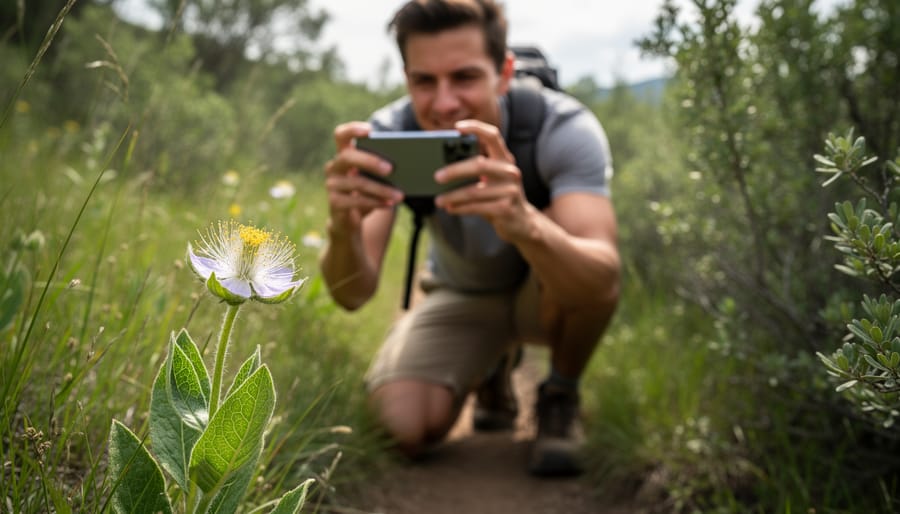
Before you head out on your plant identification adventure, let’s talk about staying safe while you explore Ontario’s trails. The good news is that plant hunting is a low-risk activity when you follow some basic precautions, and a little awareness goes a long way.
The golden rule: never, ever taste or eat any part of a plant unless you’re absolutely certain of its identification and edibility. Even experienced foragers use multiple reference sources before consuming wild plants. When you’re just starting out, keep your exploration visual and hands-off for unknown species.
Poison ivy deserves special attention because it’s everywhere in Ontario parks. The classic “leaves of three” warning is real, those clusters of three shiny leaflets can cause an itchy rash that lasts weeks. Giant hogweed, though less common, is even nastier. Its sap combined with sunlight causes serious burns and blisters, so if you spot a plant taller than you with huge umbrella-shaped white flowers, admire it from a distance and report its location to park staff.
Respect park regulations about plant collection. Most Ontario parks prohibit picking wildflowers or removing plants entirely, and for good reason. Stick to the trails to protect fragile ecosystems and root systems you can’t see. Trampling off-trail damages far more than the plant you’re examining.
Check yourself for ticks after every outing, especially if you’ve brushed against tall grasses or shrubs. Tucking pants into socks isn’t fashionable, but it works. If you have known plant allergies, wear long sleeves when identifying unfamiliar species.
Finally, embrace Leave no trace principles. Take only photos, observe without disturbing, and leave plants healthier than you found them. Your careful approach protects Ontario’s botanical treasures for the next curious explorer.
Your Step-by-Step Plant Identification Process
Start with Location and Habitat
Before you even pull out a field guide or open an app, look around. Where is this plant growing? That simple question eliminates hundreds of possibilities right away.
A plant thriving in standing water won’t be the same species you’d find on a dry, sun-baked rock. Wetland plants like cattails and marsh marigolds need wet feet, while plants clinging to Frontenac’s granite outcrops have adapted to drought and thin soil. Forest floor dwellers like trilliums prefer shade and rich leaf litter, while meadow species love full sun.
I learned this lesson vividly during a spring hike through a boggy area near Charleston Lake. I spotted bright yellow flowers hugging the edge of a shallow pool. Because they were literally growing in water, I could skip past all the forest and meadow plants in my guide and focus only on wetland species. Within minutes, I’d identified them as marsh marigolds, their habitat did half the work for me.
The Botany in a Day approach emphasizes this pattern-based thinking, grouping plants by where and how they grow. Start every identification by observing the habitat, and you’ll narrow your search dramatically before you even look closely at leaves or flowers.
Examine the Leaves Closely
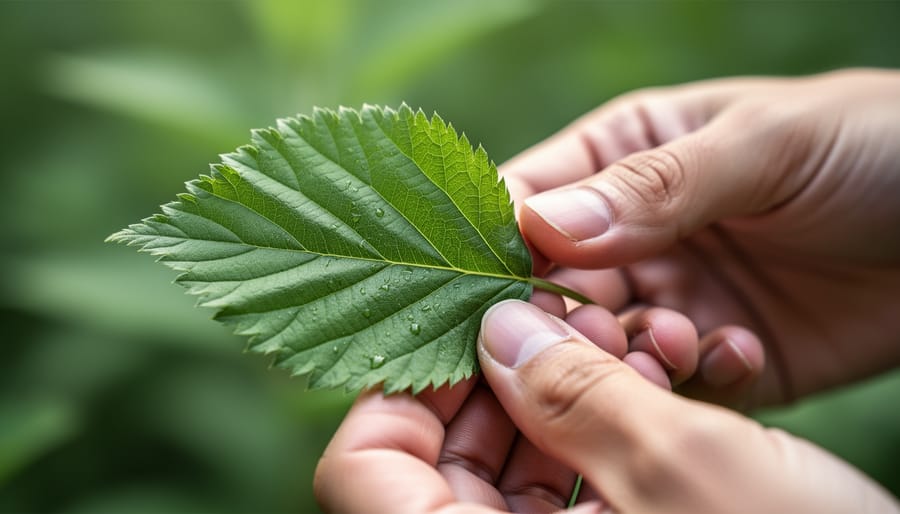
Leaves are often your best clue for identification, even when flowers aren’t blooming. Start by noting how leaves attach to the stem. Opposite leaves grow in pairs directly across from each other, maples are a classic Ontario example. Alternate leaves stagger up the stem one at a time, like you’ll see on oak trees. Whorled arrangement means three or more leaves circle the stem at the same point, which you’ll notice on some wildflowers.
Next, look at the leaf’s edge and overall shape. Is it smooth and unbroken, like a trillium’s broad oval leaf? Does it have teeth along the margin, sharp or rounded? Lobed leaves have deep indentations creating distinct sections, think of the iconic sugar maple leaf on the Canadian flag.
Here’s where it gets interesting: simple leaves have one blade per stem, even if that blade is deeply lobed. Compound leaves divide into multiple separate leaflets along a single stalk. I once mistook staghorn sumac’s compound leaves for a whole branch of separate leaves until I traced it back to one central stem. Each sumac leaf has 11 to 31 toothed leaflets arranged feather-like along the stalk.
Finally, feel the texture if the plant is safe to touch. Leaves might be fuzzy, waxy, rough, or smooth. Some Ontario ferns feel almost leathery, while mullein leaves are famously soft and velvety. These tactile details can confirm an identification when visual features alone aren’t enough.
Check Flowers, Fruits, and Stems
Flowers are often the flashiest clue, so start there. Note the color, white, yellow, pink, purple, and count the petals if you can. Three petals? Might be a trillium or spiderwort. Five petals? You’re looking at a huge group including wild roses and cinquefoils. Pay attention to how flowers are arranged: clustered at the top, dangling singly from the stem, or bunched in umbrella-like formations. These patterns help narrow your options fast.
Don’t overlook fruits and seeds, even if they seem small or dried out. Berries, seedpods, winged seeds, and fluffy seed heads all provide valuable identification hints. A bright red berry cluster in fall might be winterberry holly, while papery lantern-shaped pods suggest ground cherry.
Stems reveal secrets too. Roll the stem gently between your fingers, square stems often mean you’ve found a mint family member like wild bergamot. Check if it’s woody (shrub or tree) or herbaceous (dies back in winter). Look for hairs, thorns, or a waxy coating.
Seasonal timing matters. Spring brings flowers but few fruits. Summer offers both. Fall showcases seeds and changing foliage. Winter? You’ll rely heavily on bark, buds, and dried seed heads, trickier, but rewarding once you know what to spot.
Use Your Field Guide or App
Once you’ve gathered all your observations, it’s time to match them to an actual plant name. Open your field guide to the section that fits your plant’s type, wildflowers, trees, shrubs, or ferns. Most guides organize plants by flower color or family, making it easier to narrow down candidates.
If you’re using an app, snap a clear photo of the plant’s most distinctive feature, usually the flower or leaf. iNaturalist is fantastic for Ontario species because it taps into a community of local naturalists who review and confirm identifications. PictureThis offers instant AI suggestions that work surprisingly well, especially for common park plants like trilliums or asters.
Here’s the insider approach: never trust a single source. Cross-reference your top three matches. Does the leaf arrangement match? Does the habitat fit? Are you in the right season? I’ve learned this the hard way after confidently misidentifying a wood anemone as bloodroot because I rushed the verification.
Field guide keys use dichotomous questions, “leaves opposite or alternate?”, that systematically eliminate options. They feel tedious at first, but they teach you what actually matters. Apps are faster but less educational, so I use both. The app gets me close; the field guide builds my knowledge for next time.
Confirming Your Identification and Recording Your Finds
You’ve narrowed down your mystery plant and think you’ve got a match, but how can you be sure? Confidence in plant identification comes from a methodical verification process, not just a hunch based on one feature.
Start by cross-checking at least three distinct characteristics. If your field guide says it’s wild columbine, verify that the flower color, leaf shape, and habitat all align with the description. A single matching feature isn’t enough, poison ivy and Virginia creeper can both have three-leaflet patterns, but their other traits differ significantly. The more features that match, the stronger your identification.
Next, consult a second source. If your smartphone app suggests sugar maple, double-check against a physical field guide or a reputable botanical website. Community identification platforms like iNaturalist are invaluable here, upload your photos and Ontario naturalists will often chime in with confirmations or corrections within hours. These platforms also show you other observations of the same species in nearby locations, which helps validate your find.
When you’re reasonably certain, document everything. Take multiple photos showing the whole plant, close-ups of leaves and flowers, and the surrounding habitat. Snap a quick shot of the trail marker or park sign for location context. In your notebook, jot down the date, specific location within the park, and any observations that might not show up in photos, scent, texture, nearby companion plants. This creates a personal field record you can reference on future hikes, just like you’d do when you spot wildlife.
Be honest about your confidence level. Mark identifications as “confident” only when multiple experts or sources agree and all key features match perfectly. Otherwise, label it “probable” or “likely” in your records. There’s no shame in uncertainty, professional botanists regularly encounter tricky specimens that require closer examination or even lab analysis. Contributing your observations to citizen science projects like iNaturalist helps researchers track plant distributions across Ontario while building your identification skills through community feedback.
Where to Practice in Ontario’s Parks
You don’t need exotic destinations to start identifying plants, Ontario’s parks offer incredible variety right in your backyard. The key is choosing locations that match your skill level and provide the diversity you need to practice your new identification skills.
Frontenac Provincial Park stands out as an ideal training ground. The park sits on the edge of the Canadian Shield, creating a unique mix of ecosystems in one place. You’ll find wetlands, rocky outcrops, hardwood forests, and coniferous stands all within a few hours of hiking. This diversity means encountering dozens of different plant species on a single outing, perfect for building your identification muscles. The park also connects outdoor exploration with learning adventures like the treasure hunt experience of geocaching, making it a natural fit for discovery-minded visitors.
For absolute beginners, look for parks with interpretive trails. These self-guided routes often feature labeled trees and plants along the path, letting you check your identifications in real-time. Rouge National Urban Park near Toronto, Presqu’ile Provincial Park, and Bronte Creek Provincial Park all maintain excellent interpretive programs with seasonal guided walks led by park naturalists.
Consider timing your visit with a park’s naturalist program. Many Ontario parks offer guided botany walks during spring wildflower season (late April through May) and summer months. These walks provide expert mentorship and let you learn alongside other plant enthusiasts. Check individual park websites for their program schedules, spaces fill quickly for popular wildflower hikes.
Start close to home on familiar trails where you can return repeatedly throughout the seasons, watching how the same plants change over time.
Common Questions About Plant Identification
Starting something new always brings questions, and plant identification is no different. Here are answers to the concerns I hear most often from beginners hitting the trails.
What if I can’t find a match for my plant?
Don’t worry, it happens to everyone. Take clear photos from multiple angles, note the location and habitat, and post to iNaturalist or a local plant identification group. You can also mark it as “unidentified” in your journal and come back when the plant has flowers or fruits, which makes identification much easier.
Can I pick samples to help with identification?
In Ontario provincial parks, you’re not allowed to pick or remove any plants. Instead, take detailed photos of leaves, stems, and flowers from different angles. If you’re on private land with permission, you can collect a small leaf or two, but never dig up plants or take rare species.
What’s the best season to start learning plant identification?
Late spring through early fall offers the most visible features, flowers, fruits, and full foliage. That said, winter is actually great for learning tree identification by bark and branching patterns since there are no leaves to distract you. Start whenever your schedule allows.
Do I need to memorize scientific names?
Not at all. Common names work fine for enjoying nature and sharing discoveries. Scientific names become useful later if you want precision, since one plant might have several common names, but they’re not necessary for beginners.
How do I identify trees versus wildflowers?
Trees require looking at bark texture, branching patterns, and leaf arrangement, while wildflowers focus more on flower structure, petal count, and bloom time. Use different sections of your field guide or separate apps designed for each, most guides organize by plant type to make this easier.
The learning curve feels steep at first, but remember that experienced botanists weren’t born knowing every species. They built their knowledge one plant at a time, just like you will. Some days you’ll correctly identify five new plants, other days you’ll stare at a mystery flower for twenty minutes and still come up empty. Both experiences are part of the adventure. The key is keeping at it, each outing builds your recognition skills and confidence.
You don’t need to master every plant in Ontario to start discovering them, you just need to take that first curious step on your next park visit. Pick up a wildflower you don’t recognize, snap a photo, and work through the identification process. Whether you correctly name it or simply narrow it down to a family, you’ve started building your botanical eye.
Plant identification is wonderfully forgiving. You’ll misidentify things, second-guess yourself, and occasionally realize a week later that the “maple” you logged was actually an oak. That’s how everyone learns. Each walk sharpens your observation skills a little more. What seemed like an overwhelming green blur becomes a collection of distinct characters, the burgundy stems of joe-pye weed, the distinctive three leaves of red trillium, the fuzzy texture of mullein.
The real reward isn’t checking plants off a list. It’s the shift that happens when you start recognizing old friends on familiar trails, when you notice the first bloodroot blooming in spring, when you can point out edible serviceberries to a hiking companion. You become part of the landscape instead of just passing through it.
Pack your phone, grab a field guide if you have one, and head to your nearest Ontario park or trail. The plants are waiting to be discovered, and they’ve got stories to tell. Your adventure in interactive botany starts the moment you stop and really look.









+ There are no comments
Add yours