
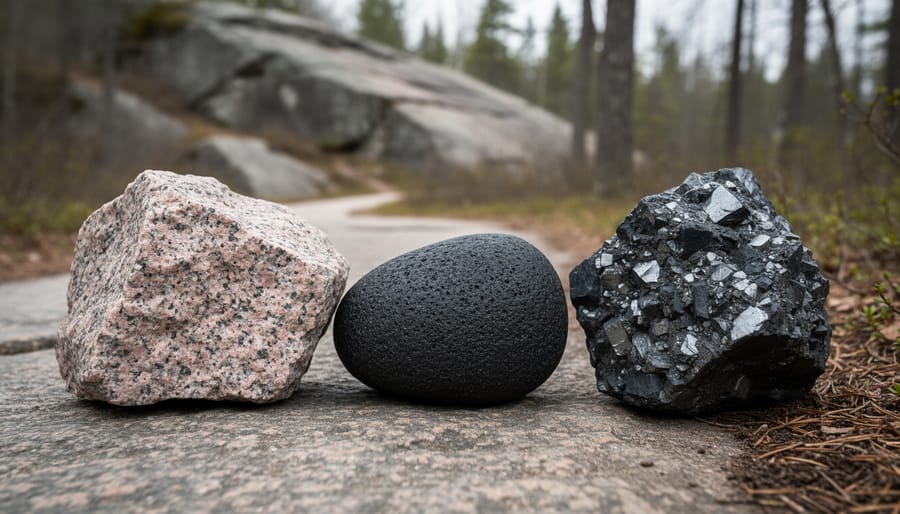
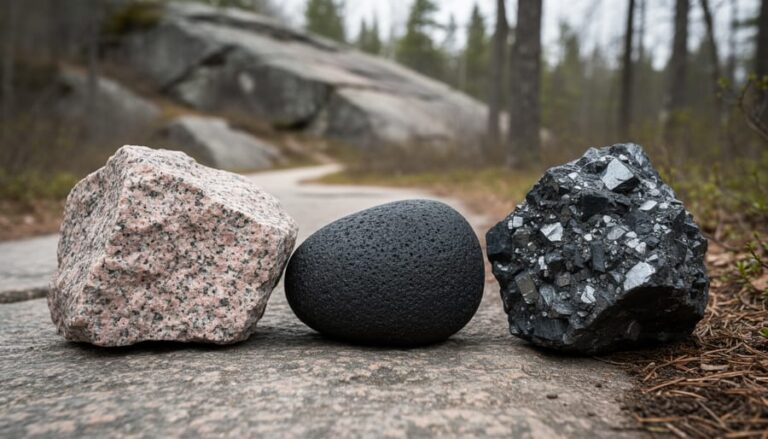
The three most common igneous rocks you’ll encounter on Ontario trails are granite, basalt, and gabbro. Each formed from cooling magma or lava under different conditions, giving them distinct appearances and textures that make field identification surprisingly straightforward once you know what to look for.
Granite catches your eye immediately with its speckled pattern of light and dark minerals, often appearing in shades of pink, gray, or white. You’ll find massive granite outcrops throughout the Canadian Shield, particularly along shorelines and exposed bedrock in cottage country. Basalt, by contrast, is usually dark gray to black and fine-grained, forming from lava that cooled quickly at Earth’s surface. Gabbro shares basalt’s dark color but reveals larger, visible crystals because it cooled slowly underground.
Learning to identify these rocks transforms any hike into a geological treasure hunt. The crystals you’re examining might be over a billion years old, formed deep within ancient mountain ranges that have long since eroded away. Each rock type tells a different chapter of Ontario’s geological story, and spotting them requires nothing more than careful observation and a willingness to crouch down for a closer look. Bring a hand lens if you have one, but your eyes alone will do the job for most field identifications.
What Makes Igneous Rocks Special in Ontario
Igneous rocks form when molten magma cools and solidifies, either deep underground or after erupting as lava. In Ontario, the igneous and crystalline Precambrian rocks of the Canadian Shield dominate the landscape, creating the rugged terrain that defines parks like Killarney, Frontenac, and Algonquin. These ancient formations, some over a billion years old, are remnants of massive geological events that shaped North America’s foundation.
What sets Ontario’s igneous rocks apart is their accessibility. Unlike many geological sites in Ontario you don’t need a geology degree to appreciate them. Walk any shield trail and you’ll encounter smooth granite domes, dark basalt outcrops, and coarse-grained gabbro walls rising directly from the path. The rocks often display dramatic colour variations, pink and white granite speckled with black mica, charcoal-grey basalt, deep green-black gabbro, that catch your eye immediately.
Touch these formations and you’ll feel the crystalline texture that tells their cooling story. Coarse crystals mean slow cooling deep underground; fine grains indicate rapid surface cooling. It’s geology you can read with your hands.
Granite: Ontario’s Signature Rock
Where to Find Granite Formations
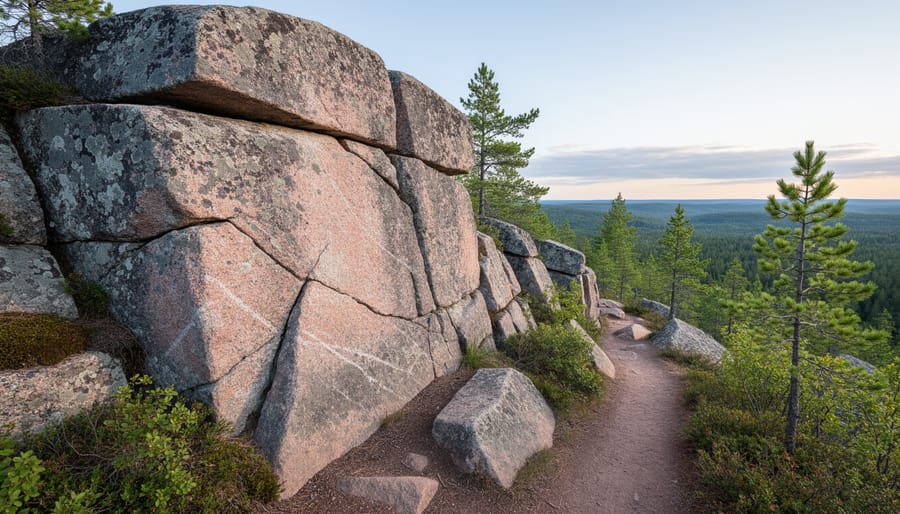
Frontenac Provincial Park stands out as one of the easiest places to see granite up close. The Arab Lake Gorge Trail takes you through towering granite cliffs that rise dramatically from the forest floor, perfect for photography and close inspection. This 2-kilometer loop is relatively gentle and suitable for most fitness levels.
In Algonquin Park, the Barron Canyon Trail delivers jaw-dropping granite walls that soar 100 meters above the Barron River. The short 1.5-kilometer walk leads to viewing platforms where you can safely observe massive vertical faces of pink and grey granite sculpted over millions of years.
Killarney Provincial Park’s La Cloche Silhouette Trail showcases the famous white quartzite ridges (metamorphosed granite), but the park’s shoreline trails reveal classic granite in all its speckled glory. Paddle along George Lake’s edges for water-level views of smooth, glacier-polished granite shores.
Closer to Toronto, the Crack Trail in Killarney and Frontenac’s Slide Lake Loop both feature accessible granite outcrops without requiring backcountry camping. Visit during spring or fall when lower vegetation makes rock features more visible. Bring sturdy footwear, granite can be slippery when wet, especially the polished surfaces near water.
What to Look For: Identifying Granite
When you’re standing on a granite outcrop in Frontenac Provincial Park, flip the rock over in your hands and you’ll see a mosaic of interlocking crystals. Look for three main minerals: glassy, translucent quartz (often grey or clear), blocky feldspar crystals (white, pink, or salmon-coloured), and flecks of black mica that catch the light like tiny mirrors.
I learned this the hard way on my first Algonquin canoe trip. I kept calling every speckled rock “granite” until a geology student pointed out the difference between coarse and fine textures. Real granite has visible crystals you can distinguish without a magnifying glass, typically ranging from rice-grain to pea-sized.
Watch for weathering patterns too. Granite often develops rounded edges and shallow depressions where softer minerals erode first, creating natural bowl shapes that collect rainwater. On vertical cliff faces, you’ll notice rectangular or blocky fracture patterns where the rock breaks along natural joints.
The best lighting for identification? Morning or late afternoon sun highlights the crystal surfaces. Run your hand across the surface, granite feels rough and granular, never smooth like river stone.
Basalt: The Dark Volcanic Rock
Basalt in Ontario’s Ancient Volcanic Past
Standing on a dark basalt outcrop in Ontario is like touching a piece of the province’s fiery past. Over a billion years ago, long before the Great Lakes existed, this region was volcanically active. Molten lava erupted from fissures in the earth’s crust, spreading across the landscape in massive flows that eventually cooled into the dense, dark rock you can see today.
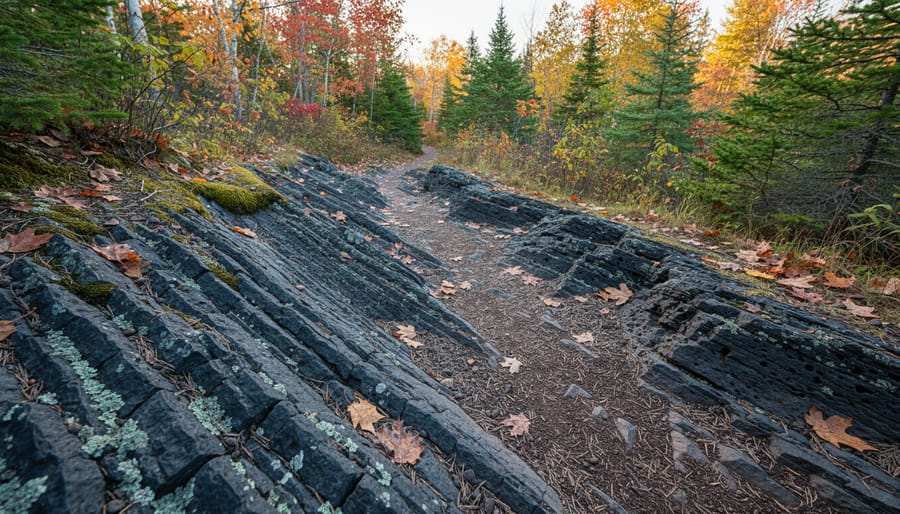
These ancient lava flows are now exposed in places like Lake Superior Provincial Park and parts of the Canadian Shield near Thunder Bay. The basalt formations there preserve a snapshot of Ontario’s Precambrian era, when volcanic activity shaped the landscape. Some outcrops still show the characteristic pillow structures formed when lava met water, creating rounded, pillow-like shapes that solidified underwater.
What makes these formations remarkable is their age and resilience. Despite a billion years of weathering, ice ages, and geological shifts, basalt outcrops remain visible because the rock is so dense and durable. When you spot a dark, fine-grained cliff face or shoreline boulder along Northwestern Ontario trails, you’re looking at evidence of eruptions that predate most life on Earth.
Spotting Basalt on Your Hike
Basalt stands out on the trail thanks to its near-black or dark grey colour, especially when wet from morning dew or recent rain. Run your hand across its surface and you’ll notice it feels smooth to slightly rough, quite different from granite’s obvious sparkle. The grains are so fine you can’t pick out individual crystals without a hand lens, giving basalt a uniform, almost velvety appearance in good light.
Look for exposed rock faces along lakeshores or where the trail cuts through bedrock. Basalt sometimes displays columnar jointing, those fascinating vertical cracks that make the rock look like a stack of hexagonal pencils standing on end. These columns form as the lava cools and contracts, creating one of geology’s most photogenic features.
When you spot an interesting formation, examine it closely but remember to follow Leave No Trace principles. Take photos instead of samples, and avoid disturbing lichen or moss growing on the rock surface. These delicate ecosystems took decades to establish and play a vital role in the park’s ecology.
Gabbro: Granite’s Darker Cousin
How Gabbro Differs from Granite and Basalt
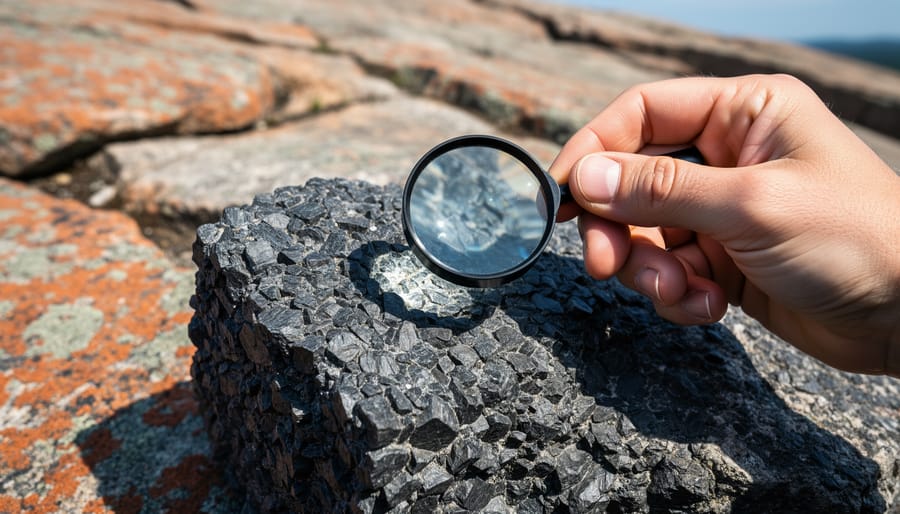
Gabbro sits right between granite and basalt in the igneous rock family tree, sharing traits with both but distinct enough to stand on its own. Think of it this way: gabbro has the same coarse, speckled texture as granite, you can see individual crystals without a magnifying glass, but it’s dark like basalt, ranging from charcoal grey to nearly black.
The key difference comes down to what’s inside. Granite gets its light colour from abundant quartz and feldspar, minerals that reflect lots of light. Gabbro, on the other hand, contains darker minerals like pyroxene and olivine, which give it that shadowy appearance. It forms the same way granite does, cooling slowly deep underground, which explains the visible crystals. Basalt forms from the same basic magma composition as gabbro, but it cools quickly at the surface, creating tiny crystals you can’t see individually.
On the trail, you’ll spot gabbro by its contradictions: dark as volcanic rock but textured like granite. It’s heavier and denser than granite too, something you’ll notice if you pick up a sample-sized piece. Once you train your eye to this combination of coarse texture and dark colour, gabbro becomes easy to distinguish from its igneous cousins.
Finding Gabbro in Ontario Parks
Gabbro tends to hide in plain sight, often forming bands or patches within larger granite outcrops along the Canadian Shield. You’ll spot it most reliably in Frontenac Provincial Park’s interior backcountry trails, where dark gabbro intrusions cut through the pink granite like geological ribbons. Killarney’s La Cloche range holds impressive gabbro exposures near George Lake, though most hikers walk right past them focusing on the white quartzite peaks overhead.
Look for gabbro where trails cross transitional zones between different rock types, stream beds and shoreline exposures work particularly well since water erosion reveals fresh surfaces. The Nipissing diabase sills in Lake Superior Provincial Park show gabbro-like textures worth examining, especially around coastal cliffs accessible from the Coastal Trail. These darker patches often weather differently than surrounding granite, creating subtle depressions or ridges that catch your eye once you know what to notice.
Interactive Ways to Explore Ontario’s Igneous Rocks
Turning a hike into a geological scavenger hunt transforms your Ontario park visit into an active learning adventure. Many parks offer interpreter-led geology walks during summer months, Frontenac Provincial Park runs excellent half-day programs where naturalists explain the Canadian Shield’s story while you examine actual outcrops. These guided experiences teach you what to look for, so future hikes become self-guided geology lessons.
For families with kids, create a simple rock identification challenge. Photograph granite, basalt, and gabbro samples at a visitor centre, then see who can spot matching rocks along the trail. Young geologists love using a hand lens to examine crystal patterns up close. Some groups combine this with a geocaching treasure hunt where geological waypoints become part of the GPS adventure.
Photography enthusiasts find igneous rocks especially rewarding subjects. Early morning or late afternoon light accentuates the texture of granite cliffs and the subtle colour variations in gabbro. Try macro shots of crystal patterns or wide-angle compositions showing how massive rock formations shape entire landscapes.
Several Ontario parks offer junior geologist programs and self-guided interpretive trails with geological markers. Algonquin’s visitor centre displays excellent rock samples with explanations, letting you study specimens before heading out to find them in their natural setting. Killarney’s La Cloche Silhouette Trail passes stunning white quartzite ridges alongside granite formations, creating a geological showcase.
Bring a small notebook to sketch what you observe, drawing forces you to notice details you’d otherwise miss. Record locations, rock characteristics, and questions to research later. This hands-on approach builds genuine expertise that enriches every future outdoor adventure.
Planning Your Rock-Hunting Adventure
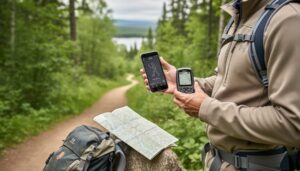
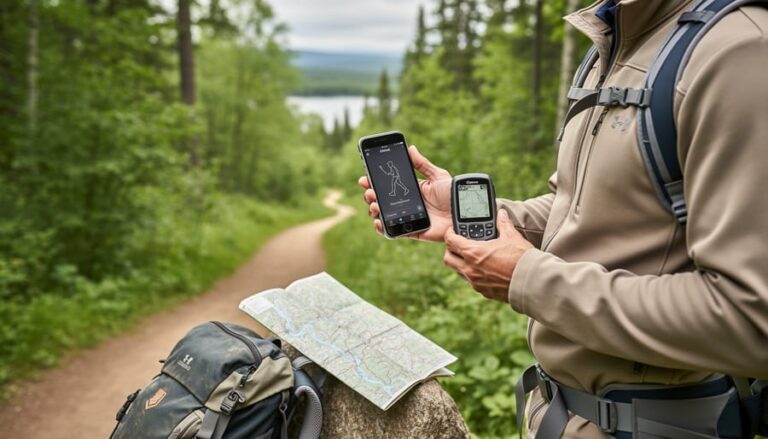
Pack light but smart for your geological adventure. A hand lens (10x magnification works well) transforms tiny mineral crystals into identifiable features, while a basic field guide to Canadian Shield rocks fits easily in your daypack. Your smartphone camera captures formations for later study, and a small notebook lets you record locations and observations without relying on memory.
Spring and fall offer ideal rock-viewing conditions in Ontario parks. Lower water levels expose shoreline formations, and fewer leaves mean better visibility of outcrops and cliff faces. Early morning light brings out the pink tones in granite and highlights the crystalline sparkle that afternoon sun can wash out.
Combine rock identification with paddling trips in Frontenac or Killarney, where waterside exposures reveal geological stories. Morning hikes give you energy for afternoon exploration, and many parks offer evening naturalist programs that complement your self-guided discoveries. Using an interactive geological time scale before your trip helps contextualize what you’ll see.
Remember that Ontario parks prohibit removing rock specimens. Photograph formations instead, sketch interesting features, or use your hand lens to examine crystals in place. This approach preserves geological features for future visitors while still giving you a rewarding learning experience. Rangers appreciate when visitors ask questions rather than pocket samples, and they often share insider knowledge about overlooked formations worth visiting.
The next time you’re standing on a windswept granite ridge in Frontenac or scrambling over dark basalt at the lakeshore, you’ll see more than just rocks, you’ll recognize the ancient story written in Ontario’s landscape. Understanding granite, basalt, and gabbro transforms an ordinary hike into a conversation with geological time, where every outcrop becomes a teaching moment and every trail reveals clues to our province’s volcanic past.
More Ontario visitors are discovering this geological dimension to their outdoor adventures, blending traditional hiking and camping with the thrill of field identification. Pack that hand lens on your next trip, pause at those cliff faces, and really look at what you’re standing on. The Canadian Shield has been waiting a billion years to tell you its story, all you need to do is pay attention to the rocks beneath your boots.
Common Questions About Ontario’s Igneous Rocks
Walking the trails of Ontario’s provincial parks naturally sparks questions about the rocks beneath your boots. Here are the answers to what curious hikers and outdoor enthusiasts most often wonder about the province’s igneous formations.
Can I take rock samples home from Ontario parks?
No, collecting rocks or minerals is prohibited in Ontario provincial parks to preserve the natural environment for everyone. You’re welcome to photograph, sketch, and closely examine rocks, but leave them where you found them so future visitors can enjoy the same discoveries.
What’s the easiest igneous rock to identify for beginners?
Granite is the most beginner-friendly because of its distinctive speckled appearance with visible crystals of white, pink, and black minerals. The coarse texture and light colour make it immediately recognizable, even without a hand lens.
Are there guided geology tours in Ontario parks?
Yes, several parks offer seasonal geology programs led by naturalists or park staff. Killarney Provincial Park and Frontenac Provincial Park occasionally run guided hikes focused on geological features, while some conservation areas partner with local geology clubs for public walks.
Which Ontario park has the best examples of all three igneous rocks?
Frontenac Provincial Park showcases excellent examples of granite, basalt, and gabbro within a relatively compact area, making it ideal for comparing these rocks side-by-side. The park’s diverse geology reflects over a billion years of Ontario’s geological story.
Beyond these common queries, many visitors wonder what tools they actually need. Honestly, your eyes are your most important equipment. A basic 10x hand lens helps you see crystal structure more clearly, while a simple pocket field guide keeps identification straightforward without weighing down your pack. A notebook for sketching what you observe often proves more valuable than expensive geology hammers, which aren’t permitted in parks anyway.
If you’re hungry to learn more after your trail experiences, the Ontario Geological Survey offers free online resources and maps. Local rock and mineral clubs across the province welcome newcomers and organize field trips to approved collecting sites outside park boundaries, where taking samples is allowed with landowner permission.




+ There are no comments
Add yours