
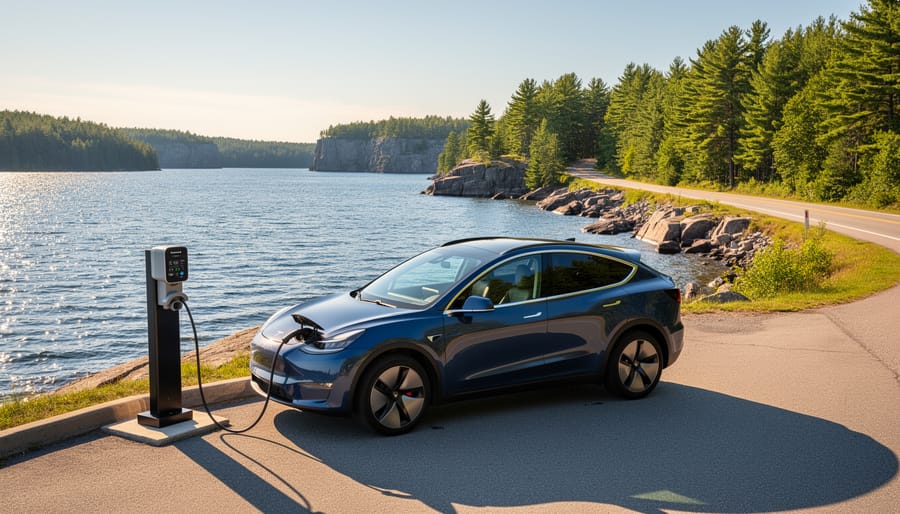
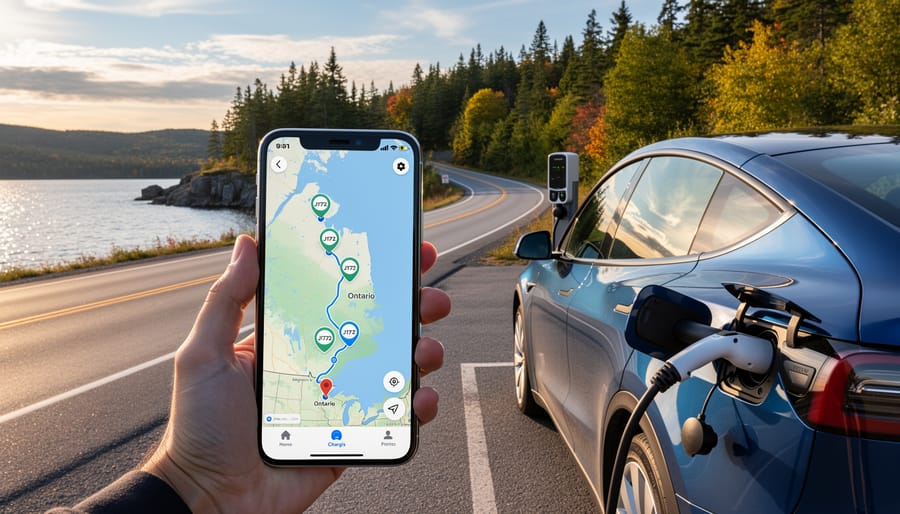
Download the PlugShare or ChargePoint app before departing, filtering specifically for J1772 connectors along your planned route through Ontario’s most stunning landscapes. These Level 2 charging stations are your reliable companions for leisurely scenic drives, adding 25-40 kilometers of range per hour while you explore waterfalls, hiking trails, and charming small towns.
Plan routes with 2-3 hour charging stops at destinations you actually want to visit. The Bruce Peninsula offers J1772 stations in Tobermory where you can charge while hiking the Grotto, while Muskoka’s cottage country provides chargers near lakefront restaurants and artisan shops. Prince Edward County wineries increasingly feature J1772 stations, turning a necessary charging pause into an afternoon of tastings and farm-to-table dining.
Build buffer range into every trip segment, treating your vehicle’s 80 percent charge as your actual maximum. Ontario’s rural highways between charging stations can stretch 100-150 kilometers, and winter temperatures reduce EV range by up to 30 percent. This conservative approach transforms potential range anxiety into confident exploration.
Pack a portable J1772 charging cable and research accommodation options with available outlets. Many Ontario parks, bed and breakfasts, and campgrounds now advertise EV-friendly amenities, though charging speeds vary dramatically. A standard 120-volt outlet delivers only 6-8 kilometers per hour, making overnight stays essential for meaningful range recovery.
The reality is this: electric vehicles and scenic road trips pair beautifully when you shift your mindset from gas-station efficiency to destination-based charging. Your EV becomes a reason to slow down, spend more time at Ontario’s hidden gems, and discover places you’d otherwise speed past. The charging network across Ontario’s tourist regions has matured remarkably over the past three years, making range anxiety increasingly obsolete for prepared travelers.
Why J1772 Charging Makes Ontario’s Scenic Routes EV-Friendly
Here’s something that changed my EV road-tripping game completely: discovering that J1772 charging stations are practically everywhere along Ontario’s most beautiful routes. I remember my first electric vehicle – I was hesitant about venturing beyond the city, worried I’d end up stranded somewhere between here and Muskoka. Turns out, that concern was totally unfounded.
The J1772 charging standard has become Ontario’s EV lifeline, and you’ll find these chargers dotting parking lots at conservation areas, wineries, heritage sites, and even trailheads throughout the province. What makes this particularly exciting is that nearly every electric vehicle sold in North America (except Teslas, which need an adapter) uses this universal plug-and-play connection.
Let me break down the charging options in practical terms. Level 1 charging uses a regular household outlet – think overnight charging at your cottage or campsite. It’s slow, adding about 5-8 kilometres of range per hour, but perfect when you’re settled in for the evening. Level 2 chargers are the workhorses you’ll encounter most often at tourist destinations. These add roughly 30-50 kilometres per hour, so a two-hour lunch stop in Prince Edward County could easily top you up for the drive home. DC fast charging (which works with J1772-equipped vehicles through a separate connector) delivers 150-300 kilometres in 30 minutes – ideal for highway corridor stops.
Here’s my insider tip: download apps like PlugShare or ChargePoint before your trip. They show real-time charger availability and user reviews, helping you plan stops around activities rather than anxiety. I’ve discovered incredible hiking trails and hidden-gem cafes simply because they happened to have chargers nearby.
The beauty is that scenic routes like the Waterfront Trail, Algonquin’s Highway 60 corridor, and the Bruce Peninsula are now genuinely accessible to EV drivers. That freedom to explore without constantly checking your battery percentage? That’s what transforms electric vehicles from city cars into adventure-ready companions.
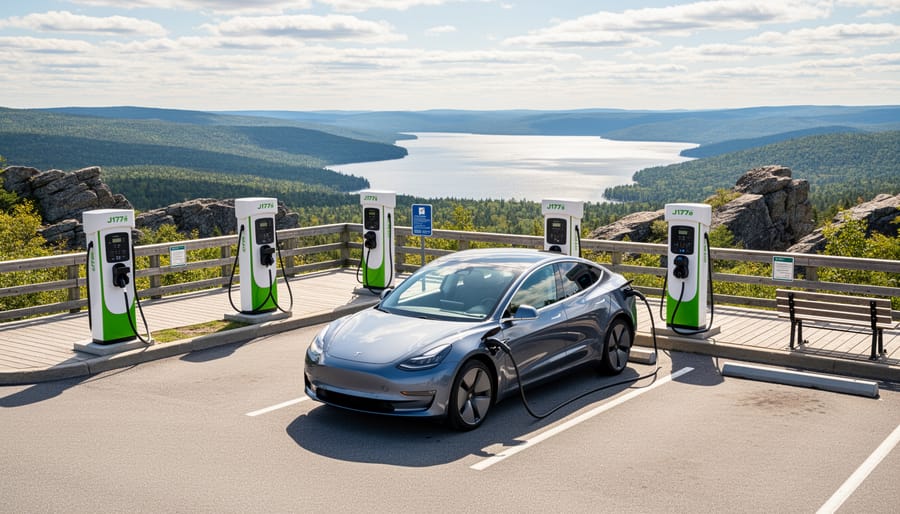
Planning Your EV Scenic Drive: Charging Strategy Basics
Best Apps and Resources for J1772 Station Mapping
Finding J1772 charging stations along your Ontario adventure doesn’t have to be stressful! I’ve road-tested several apps during my own electric journeys, and these three have become my trusted travel companions.
PlugShare is my go-to resource – think of it as the ultimate community-driven charging map. Real EV drivers share photos, leave reviews, and update station status in real-time. I once avoided a broken charger in Muskoka thanks to a PlugShare alert posted just hours earlier! The app shows filters for J1772 connectors specifically, so you won’t waste time checking incompatible stations.
ChargePoint combines excellent mapping with seamless payment integration. Their network spans many Ontario destinations, and you can start charging sessions directly through the app. I appreciate their reliable stations at provincial parks and tourist hubs – perfect for topping up while you explore.
For Ontario-specific planning, check out PlugNDrive’s comprehensive charging station map tailored to our province. They include helpful info about nearby attractions and amenities, which makes route planning feel less like homework and more like trip dreaming.
Pro insider tip: Download all three apps before heading out. Cell service can be spotty in remote areas, but these apps cache recent data to help you navigate even when you’re off the grid.
Timing Your Charges Around Activities
One of my favorite tricks for stress-free EV road trips is treating charging stops as built-in break times rather than inconveniences. I’ve learned to plan my routes so that when my battery needs a boost, I’m already somewhere I want to be.
For example, if you’re driving along the Niagara Parkway, time your charging stop in Niagara-on-the-Lake during lunch. Many J1772 chargers there are within walking distance of charming cafes and wineries. Grab a leisurely meal at one of the local restaurants, stroll through the historic downtown, and return to a fully charged vehicle. What would feel like wasted time at a highway rest stop becomes an enjoyable part of your adventure.
Hiking enthusiasts should look for charging stations near trailheads. Some conservation areas and provincial parks now offer charging facilities. Start your charge, hit the trail for an hour or two, and come back ready to continue your journey. It’s the perfect synergy between eco-friendly travel and outdoor exploration.
I also recommend downloading charging apps that show nearby amenities. You’ll discover that many charging locations are strategically placed near attractions, farmers markets, or scenic lookouts. During my last trip through Prince Edward County, I found a charger right beside a local artisan shop where I spent a delightful 45 minutes browsing handmade crafts while my car powered up. The key is shifting your mindset from “waiting to charge” to “charging while exploring.”
Scenic Route #1: Thousand Islands Parkway with J1772 Charging Stops
Picture this: you’re cruising along the St. Lawrence River, windows down, with islands dotting the horizon like emeralds scattered across blue velvet. The Thousand Islands Parkway between Gananoque and Brockville is one of Ontario’s most breathtaking drives, and here’s the great news – it’s completely EV-friendly with J1772 charging stations strategically placed along the 37-kilometer route.
Start your journey in Gananoque, where you’ll find reliable J1772 chargers at the municipal lot on King Street East. Top up your battery while grabbing coffee at one of the local cafés – you’ll want to start with a full charge to maximize your flexibility for spontaneous stops. The parkway itself is fairly short, but trust me, you’ll be pulling over constantly for photo opportunities.
About 8 kilometers in, make your first stop at the Brown’s Bay Lookout. The panoramic views here are absolutely stunning, especially during golden hour when the light catches the water just right. Keep your eyes peeled for herons and ospreys – I’ve spotted them fishing here more times than I can count.
Continue another 15 kilometers to Ivy Lea, home to the iconic Thousand Islands Bridge. There’s a J1772 charging station at the Thousand Islands Parkway Pavilion, perfect for a mid-journey top-up while you explore the visitor center. The interpretive displays here tell fascinating stories about the region’s shipwrecks and rum-running history during Prohibition.
For lunch, the nearby Ivy Lea Campground offers charging access (call ahead to confirm availability) and picnic areas with unbeatable water views. Pack a lunch to keep things eco-friendly and budget-conscious.
The final stretch to Brockville takes you past Landon Bay, where calm mornings create mirror-like reflections of the surrounding islands – absolutely magical for photography enthusiasts. In Brockville, you’ll find multiple J1772 stations downtown, including one at the Brockville Arts Centre on King Street West.
Here’s an insider tip: download the PlugShare app before you leave. While the main stations are reliable, locals often share access to their home chargers along the route, and the EV community here is incredibly welcoming. Also, plan your drive for weekdays if possible – summer weekends get busy, and you might wait for charging spots at peak times.
The entire route uses minimal battery thanks to the flat, leisurely terrain, but starting with 80 percent charge gives you peace of mind for detours and air conditioning on hot days.
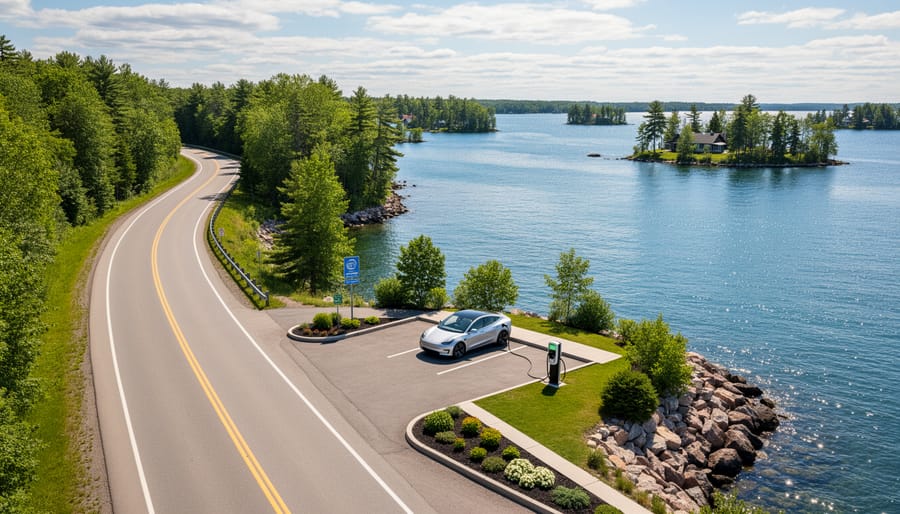
Scenic Route #2: Muskoka Lakes Loop and Charging Infrastructure
Picture yourself cruising through cottage country with the windows down, pine-scented air filling your EV, and not a worry about finding your next charge. The Muskoka Lakes Loop is absolutely dreamy for electric vehicle road trippers, and I’m thrilled to share that the charging infrastructure here has come a long way in recent years.
Starting your loop in Gravenhurst, you’ll find J1772 chargers conveniently located near the town’s historic downtown core. I always recommend plugging in at the Muskoka Wharf area, where you can spend your charging time strolling along the waterfront boardwalk or grabbing a locally-roasted coffee. The chargers here typically give you enough time to explore the shops and maybe even catch a Muskoka Steamship cruise departure if you’re lucky.
As you head north toward Bracebridge, keep your eyes peeled for the stunning vistas along Highway 118. Bracebridge itself offers several charging options near the downtown area, and here’s an insider tip: time your charge to coincide with lunch at one of the waterfront patios overlooking Bracebridge Falls. The sound of rushing water makes for the most peaceful charging stop you’ll ever experience.
Huntsville, the northern anchor of your loop, has expanded its charging network considerably. You’ll find J1772 stations near the downtown core and at select accommodations. While your vehicle charges, take a walk through the charming Main Street with its brick buildings and local boutiques. The Huntsville Farmers’ Market runs on Thursdays if you’re there mid-week, offering fresh local produce perfect for a picnic lunch.
The beauty of this route is that charging times become part of your vacation rather than an interruption. Between Gravenhurst and Huntsville, you’re looking at roughly 40 kilometers, well within any EV’s comfortable range. This means you can choose where to charge based on what you want to explore rather than desperately searching for the next available plug.
Pro tip for eco-conscious travelers: many of Muskoka’s charging stations are increasingly powered by renewable energy sources. Ask the local tourism offices about green charging options to minimize your carbon footprint even further. Pack a reusable water bottle and some trail snacks, because you’ll definitely want to make spontaneous stops at those “oh wow” viewpoints overlooking the lakes. The freedom of EV travel in Muskoka means you can be spontaneous while staying sustainable.
Scenic Route #3: Niagara Escarpment and Bruce Peninsula EV Adventure
If you’re craving dramatic limestone cliffs, crystal-clear turquoise waters, and some of Ontario’s most breathtaking hiking trails, pack your EV and head north to the Bruce Peninsula. I’ll be honest—the first time I made this trip, I was a bit nervous about charging availability in more remote areas. But I quickly discovered that with a little planning, this route is absolutely doable and worth every kilometer.
Start your journey in Owen Sound, which serves as your gateway to the Bruce. There are several J1772 charging stations here, including ones at the Grey County Administration Building and various municipal lots. Top up while you grab lunch downtown—the local cafes along the harbor are fantastic, and you’ll want the energy for what’s ahead.
From Owen Sound, it’s about 100 kilometers to Tobermory, the jewel at the peninsula’s tip. The drive itself follows Highway 6, winding through charming villages like Wiarton and Lion’s Head. In Lion’s Head, there’s a J1772 charger at the municipal office that’s perfect for a quick boost while you stretch your legs along the harbor. Pro tip: if you’re there in autumn, the sunset views from Lion’s Head lookout will take your breath away.
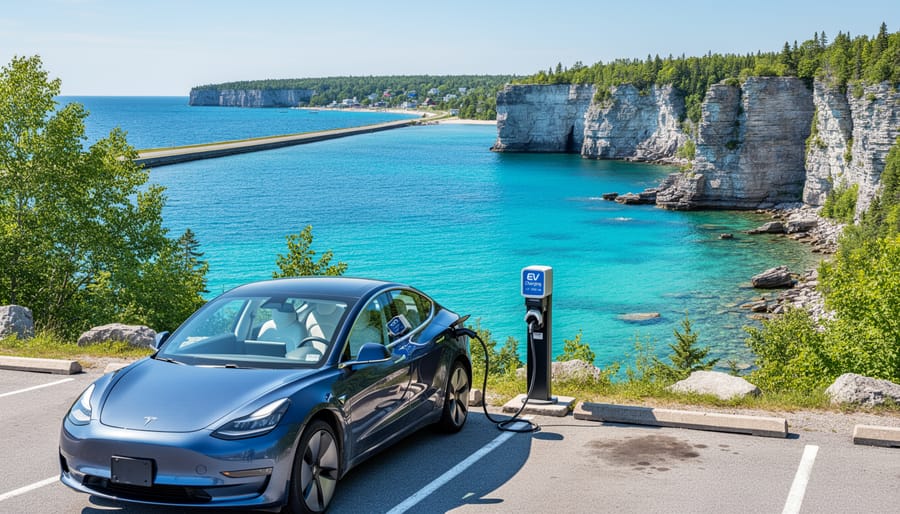
Tobermory is your home base for exploring the peninsula’s highlights, and thankfully, there are J1772 charging options at the municipal parking areas. You’ll definitely want to spend at least two days here. The Bruce Trail’s northern terminus offers stunning hikes along those iconic white cliffs, and the Grotto—a magical cave with impossibly blue water—is absolutely unmissable. Just remember to book your parking permit well in advance during peak season.
For the eco-conscious traveler, consider staying at one of the smaller family-run accommodations in Tobermory that offer EV charging. Many have embraced sustainable tourism practices, and supporting these local businesses feels good.
Don’t miss Fathom Five National Marine Park, where you can kayak over shipwrecks in water so clear you’ll feel like you’re floating on air. If you’re camping, Cyprus Lake Campground within Bruce Peninsula National Park provides a truly immersive nature experience, though you’ll want to charge fully in town before heading to the campground.
The return journey offers opportunities to explore more conservation areas. Stop at the Malcolm Bluff and Skinner’s Bluff sections of the Bruce Trail for shorter hikes with equally impressive views. With strategic charging stops and a sense of adventure, this route proves that EV travel and wilderness exploration make a perfect match.
Hidden Gem Routes with Reliable J1772 Access
Sometimes the best adventures happen on roads less traveled, and these hidden gem routes prove you don’t need a week-long vacation to experience Ontario’s magic. What makes these drives even better? Each one has reliable J1772 charging stations strategically placed so you can explore without constantly checking your battery level.
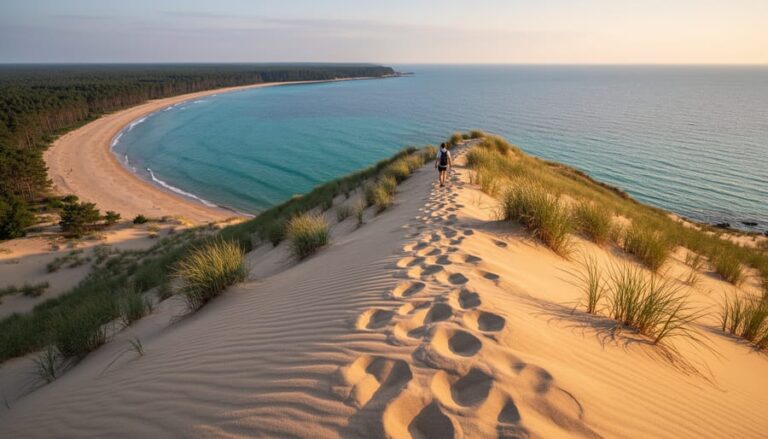
Prince Edward County wine country feels like you’ve stepped into a European countryside, minus the passport hassle. This peninsula jutting into Lake Ontario offers rolling vineyards, farm-to-table restaurants, and that laid-back vibe every stressed-out city dweller craves. Park your EV at the Picton recreation center where you’ll find Level 2 chargers, then spend the afternoon hopping between wineries like Norman Hardie and Rosehall Run. Here’s an insider tip: visit mid-week during harvest season in late September when the crowds thin out but the tasting rooms stay open. The Sandbanks Provincial Park offers another charging station near those famous sand dunes, perfect for combining beach time with your wine tour.
Head north to the Haliburton Highlands for a completely different experience. This area screams quintessential Canadian cottage country, with crystal-clear lakes surrounded by pine forests and granite outcroppings. The charming village of Haliburton has public chargers right downtown, giving you plenty of time to browse local art galleries and grab lunch while your car powers up. I’ve found this route particularly stunning during fall colors, when the maples put on their annual show. Pack a kayak or canoe because many access points are within a short drive of charging stations.
The Kawartha Lakes region rounds out this trio of manageable escapes. Peterborough serves as your charging hub with multiple J1772 stations throughout the city, including one near the famous Peterborough Lift Lock, a National Historic Site worth exploring. From there, loop around the various lakes, stopping at small-town bakeries and roadside markets selling fresh produce. The region’s flat terrain makes it especially efficient for EV range, meaning you’ll squeeze extra kilometers from each charge. Weekend warriors love this route because you can leave Friday evening and return Sunday without feeling rushed.
What to Do If Your J1772 Station Is Occupied or Broken
Picture this: you’re rolling into Tobermory after a gorgeous drive up the Bruce Peninsula, ready to top up your EV before exploring the Grotto, and someone’s parked at the only J1772 station with a full battery while they grab lunch. We’ve all been there, and honestly, it’s become one of those teachable moments in EV travel etiquette.
First things first, don’t panic. Most charging stations have accompanying apps like ChargePoint or FLO that show real-time availability and estimated charging completion times. Before you even arrive, check these apps to scout backup locations. I learned this the hard way near Algonquin Park when the visitor center charger was out of order. A quick app check revealed a hotel three kilometers down the road with available J1772 stations, and the front desk graciously let me charge while I enjoyed their café.
When you encounter an occupied charger, look for contact information left on the dashboard. Many courteous EV drivers leave their phone numbers so you can text when you arrive. If there’s no note and the car appears fully charged, a gentle knock at nearby businesses often locates the owner. At Niagara-on-the-Lake wineries, I’ve seen EV owners develop an informal system, leaving notes saying “Back at 2 PM, please move if needed.”
For broken stations, report them immediately through the network’s app. Take photos and note the station ID. PlugShare community reports are invaluable here, as they alert other travelers in real-time.
My insider tip? Always have a Plan B and C. Download multiple charging apps before your trip, keep your battery above 20 percent when possible, and embrace the adventure. That “detour” to find working chargers in Port Hope led me to discover the most charming bakery I’ve ever visited.
So there you have it—your roadmap to experiencing Ontario’s most breathtaking scenery behind the wheel of your EV, with J1772 charging stations waiting to power your adventures. The freedom of electric road-tripping might seem daunting at first, but as you’ve seen, Ontario’s charging network has evolved beautifully to support your wanderlust. You’re not sacrificing anything by choosing an EV for your scenic tours; you’re actually gaining something special.
Think about it: those 20-30 minute charging stops aren’t interruptions—they’re invitations to stretch your legs on a lakeside trail, grab a locally-roasted coffee, or chat with fellow travelers about hidden gems you might have missed. Your carbon footprint shrinks with every silent kilometer, letting you explore Ontario’s natural wonders while actually protecting them for future generations.
I’ve found that the planning process itself builds anticipation. Mapping out charging stops along the Georgian Bay Coastal Route or through Muskoka cottage country becomes part of the adventure, not a chore. And honestly, there’s something deeply satisfying about gliding past gas stations, knowing your next “fuel stop” comes with a view.
Now it’s your turn. Have you discovered an amazing roadside lookout near a charging station? Found a perfect lunch spot that happens to have Level 2 chargers? Share your EV road trip stories and tips—your experiences help build a community of eco-conscious explorers making Ontario’s scenic routes accessible to everyone.






+ There are no comments
Add yours