

Look beneath your feet during your next Ontario park visit—those ancient rocks tell stories spanning billions of years, and you don’t need a geology degree to read them. Start by visiting the Canadian Shield exposures at Frontenac Provincial Park, where 1.2-billion-year-old Precambrian granite rises dramatically from forest floors, creating natural climbing walls and photo-worthy landscapes perfect for hands-on exploration. Bring a basic field guide and practice identifying common rock types like granite, gneiss, and marble by observing crystal patterns, colors, and textures—running your fingers across these surfaces connects you directly with Earth’s deep history.
Combine your geological discoveries with outdoor adventure activities by mapping rock formations using smartphone GPS apps, which transforms casual hiking into purposeful scientific observation that kids and adults alike find thrilling. Pack a small magnifying glass, camera, and notebook to document fascinating features like glacial striations, mineral veins, or fossils embedded in limestone outcrops—these tools turn passive sightseeing into active learning experiences.
Ontario’s geological playground offers something truly special: accessibility. Unlike remote field sites requiring specialized equipment, our provincial parks provide well-marked trails leading directly to world-class rock formations where families can touch, photograph, and study geological wonders safely. Whether you’re tracing fault lines, examining weathering patterns, or simply marveling at how glaciers carved the landscape, these tangible connections to Earth’s timeline create unforgettable memories while deepening your appreciation for the ground supporting every adventure.
Why Ontario Is a Geological Treasure Trove
Imagine standing on rock that’s older than multicellular life itself. Not in some remote corner of the world requiring special permits and expedition gear, but right here in Ontario, perhaps just a weekend drive from your home. That’s the magic of exploring geology in this province—you’re literally walking on billions of years of Earth’s history, and it’s surprisingly easy to reach.
Ontario sits atop one of the planet’s most ancient foundations: the Canadian Shield. This massive horseshoe of Precambrian rock wraps around Hudson Bay and forms the geological backbone of our province. We’re talking about formations that date back 2.5 to 4 billion years—rock that was here when the atmosphere was still forming, when the only life on Earth was single-celled organisms floating in primordial seas.
Here’s what makes Ontario special: unlike many geological wonders hidden in museums or buried deep underground, ours are right there at the surface. Glaciers did us a favor about 10,000 years ago, scraping away softer sediments and exposing the ancient bedrock beneath. Drive north of Toronto for an hour or two, and you’ll see these time capsules everywhere—in road cuts, along shorelines, and throughout provincial parks.
I remember my first real encounter with the Shield on a camping trip near Sudbury. Our guide pointed to pink and grey swirls in the granite and explained we were looking at minerals that crystallized before dinosaurs, before forests, before anything we’d recognize as life. It completely shifted how I saw the landscape. Suddenly, every rocky outcrop became a story worth reading.
The best part? You don’t need a geology degree to appreciate these wonders. Ontario’s geological sites are remarkably accessible, with well-marked trails, interpretive signs, and park staff eager to share their knowledge. Whether you’re a curious family looking for an educational adventure or a serious rock hound hunting for specimens, Ontario’s ancient stones are waiting to tell their stories.
Reading the Rocks: What You’re Actually Looking At
The Canadian Shield’s Greatest Hits
Ontario’s rocky foundation is like Earth’s personal photo album—billions of years old and absolutely packed with stories. The Canadian Shield, that massive horseshoe of ancient rock wrapping around Hudson Bay, is your backstage pass to some of the planet’s oldest material. We’re talking rocks that were already ancient when dinosaurs showed up!
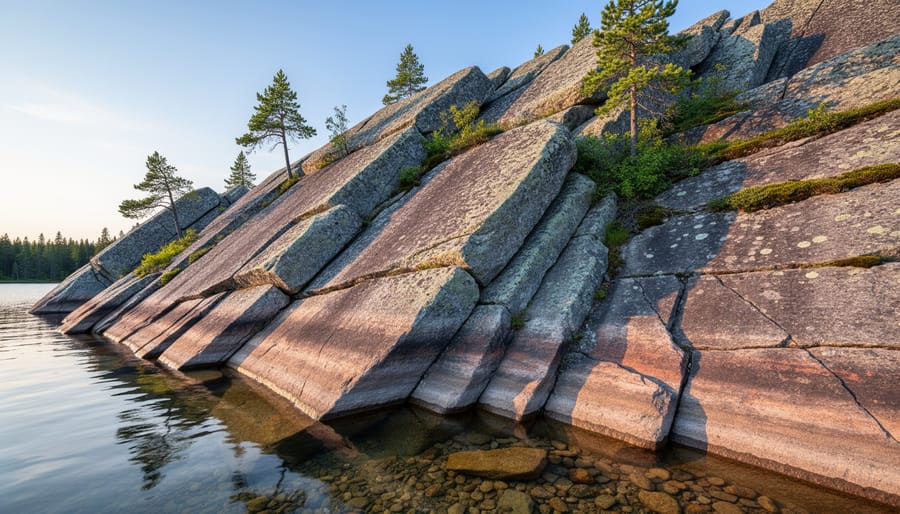
Granite is the star of the show here, and you’ll recognize it everywhere once you know what to look for. Those speckled pink, grey, and black rocks dotting cottage country? That’s granite. Think of it as nature’s confetti, frozen in stone—each speck is actually a different mineral crystal that formed as molten rock slowly cooled deep underground. The pink bits are feldspar, the glassy grey is quartz, and those dark flecks are mica or hornblende.
Then there’s gneiss (pronounced “nice”—geology’s favourite pun). This striped beauty looks like someone swirled chocolate and vanilla batter together, creating distinctive light and dark bands. These stripes tell an epic tale: gneiss started as something else entirely—maybe granite, maybe sedimentary rock—then got squeezed and heated under immense pressure until it transformed completely.
Here’s an insider tip: visit exposed rock faces after a light rain. The water brings out the colours and patterns dramatically, making those ancient stories pop like never before. Plus, you’ll avoid the crowds who stayed home because of a few sprinkles!
Glacial Signatures Everywhere You Look
Once you know what to look for, Ice Age fingerprints are surprisingly easy to spot on Ontario’s rocky landscapes. Think of yourself as a geological detective—the evidence is literally written in stone!
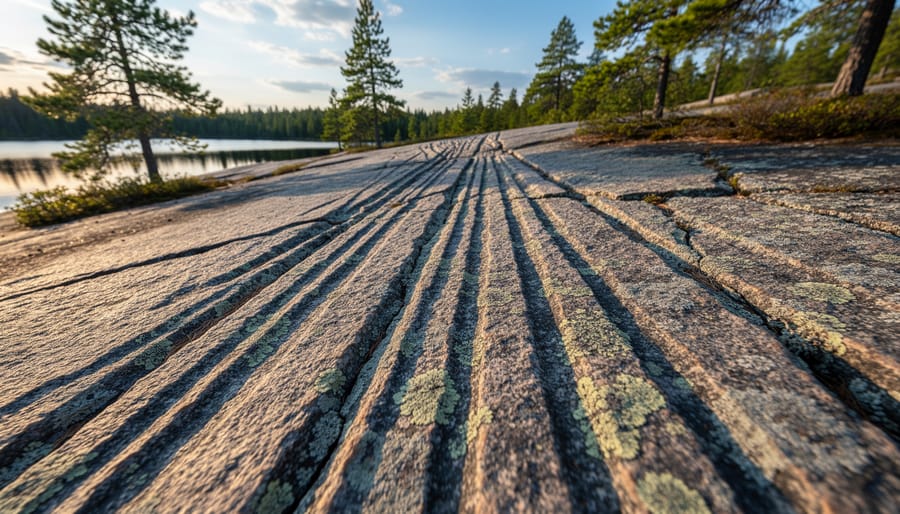
Start with glacial striations, those long scratch marks etched into bedrock. Picture an enormous ice sheet, thousands of feet thick, dragging boulders and debris across the landscape like sandpaper over wood. At places like Killarney Provincial Park’s rocky shorelines, you can run your fingers along these grooves and feel the direction the glacier traveled. The striations often run parallel to each other, creating a pattern that’s unmistakable once you’ve seen it.
Keep your eyes peeled for erratics—those out-of-place boulders sitting randomly in fields or forests. These hitchhikers rode the glacier from distant locations, sometimes hundreds of kilometers away. You’ll find impressive examples scattered throughout the Canadian Shield. The rock type often doesn’t match the surrounding bedrock, which is your first clue.
Polished rock surfaces are another giveaway. Glaciers acted like massive buffing machines, creating smooth, rounded surfaces that catch sunlight beautifully. Look for this polished appearance on exposed bedrock along hiking trails, especially after rainfall when the shine is most pronounced.
Insider tip: Visit these features in early morning or late afternoon when angled sunlight makes striations more visible. Bring a field guide or geology app to help identify rock types, and always practice Leave No Trace principles—observe without removing these irreplaceable geological treasures.
Top Interactive Geological Sites in Ontario Parks
Killarney Provincial Park: White Quartzite Wonderland
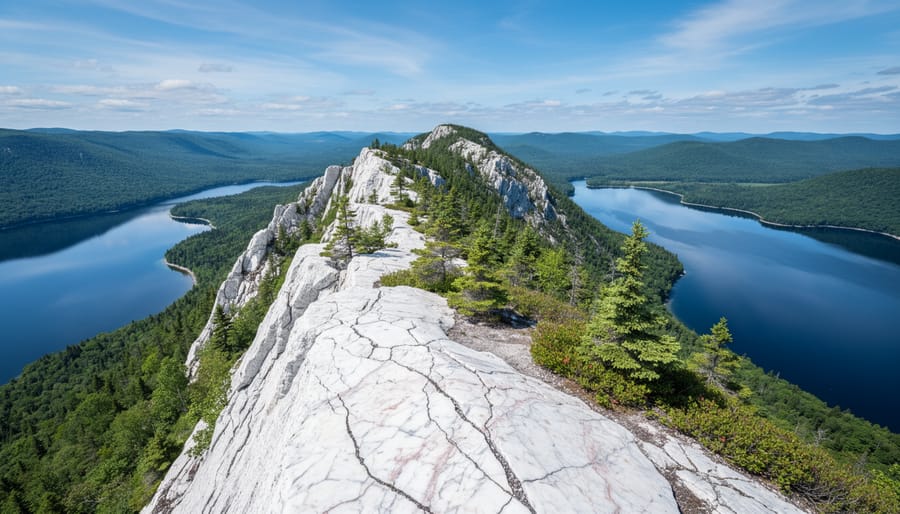
Picture this: you’re standing on a ridge so white it practically glows in the sunlight, surrounded by ancient rock formations that tell a two-billion-year-old story. Welcome to Killarney Provincial Park, where the Canadian Shield puts on its most dramatic show.
The park’s signature white quartzite ridges create an otherworldly landscape that looks more like the Mediterranean than Ontario. These brilliant white rocks contrast beautifully with pink granite outcrops and cobalt-blue lakes, making it a photographer’s paradise. The La Cloche Mountains here are remnants of peaks that once rivaled the Himalayas in height.
For the best geological experience, tackle the La Cloche Silhouette Trail, though fair warning—it’s a challenging 78-kilometer loop. If you’re after something more manageable, the Crack Trail offers spectacular views with a moderate 6-kilometer round trip. You’ll scramble through a literal crack in the quartzite and emerge to breathtaking panoramas from the ridgetop.
Insider tip: visit in early morning or late afternoon when the low-angle sun makes the white quartzite absolutely luminous. Pack a geology hammer (permitted for personal observation only, not collection), and bring plenty of water—those white rocks reflect serious heat in summer. The park’s backcountry campsites on George Lake let you wake up surrounded by these geological wonders.
Bon Echo Provincial Park: Ancient Rock Art Meets Geology
Picture yourself paddling alongside one of Ontario’s most dramatic rock faces—a sheer cliff rising 100 meters straight from the water, adorned with centuries-old Indigenous artwork. That’s Mazinaw Rock at Bon Echo Provincial Park, and it’s an absolute must-see for geology enthusiasts.
This massive granite cliff, stretching over 1.5 kilometers along Mazinaw Lake, tells two powerful stories. Geologically, you’re looking at Canadian Shield bedrock shaped by ancient volcanic activity and glacial forces. The vertical fractures and layered formations reveal how this rock cooled and cracked millions of years ago. But what makes Bon Echo truly special are the 260 ochre pictographs created by Anishinaabe peoples between 400 and 1,100 years ago—sacred art painted directly onto the geological canvas.
The best way to experience this wonder? Rent a canoe right at the park. The calm waters make it perfect for beginners, and you can paddle right up to the cliff face for an intimate view. Early morning offers the calmest conditions and stunning light on the rock.
Insider tip: Grab the free interpretive guide from the visitor center that helps you locate and understand specific pictographs. Binoculars are handy too! Remember to keep a respectful distance from the rock face—these are protected cultural sites. This accessible geological adventure combines physical activity with cultural appreciation and geological discovery all in one unforgettable paddle.
Frontenac Provincial Park: A Hands-On Learning Laboratory
Nestled in the heart of the Canadian Shield between Kingston and Sharbot Lake, Frontenac Provincial Park is an absolute gem for hands-on geological discovery. I remember my first visit here—I was blown away by how you can literally touch rocks that are over a billion years old!
The park showcases stunning examples of Precambrian granite and metamorphic rocks, with pink granite outcrops that seem to glow in the late afternoon sun. What makes Frontenac special is how accessible these formations are. The Big Salmon Lake Trail is perfect for families, offering easy access to smooth granite shorelines where kids can run their hands over ancient striations left by glaciers thousands of years ago.
For a more immersive experience, try the Arab Lake Gorge Trail. This 2-kilometer route takes you through a dramatic landscape of fractured rock faces and narrow passages where you can spot quartz veins threading through the granite—nature’s own artwork.
Insider tip: Join one of the park’s naturalist-led programs during summer weekends. These enthusiastic guides bring geological stories to life, explaining how the landscape was shaped without making you feel like you’re back in science class. They’ll even show you where to find the best examples of folded rock layers.
Pack a hand lens if you have one—examining the crystal structures up close adds another dimension to your exploration while keeping things eco-friendly and non-invasive.
Other Notable Geological Hot Spots
Beyond the famous destinations, Ontario hides some spectacular geological treasures that deserve your attention. The Niagara Escarpment, a UNESCO World Biosphere Reserve, stretches over 700 kilometers from Niagara to Tobermory, offering countless access points for rock enthusiasts. You’ll find ancient fossils embedded in limestone cliffs that date back 400 million years—bring a magnifying glass to spot tiny marine creatures frozen in time. Bruce Trail hikers can explore dramatic cliff faces and waterfalls along this incredible formation.
Lake Superior’s north shore presents some of Canada’s oldest exposed rock, including the famous Pukaskwa pits—mysterious ancient depressions carved into coastal bedrock. Kayakers get the best views of towering basalt columns and pink granite beaches that glow at sunset. Pack waterproof bags for your camera—you won’t want to miss these shots.
Sleeping Giant Provincial Park showcases the dramatic Thunder Bay formation, where 1.2-billion-year-old diabase sills create the iconic sleeping giant silhouette. The Top of the Giant Trail rewards determined hikers with panoramic views and close encounters with columnar rock formations. Visit during weekdays in September for smaller crowds and stunning fall colors reflecting off ancient stone. Remember to wear sturdy boots—these trails traverse genuine geological history, and the terrain demands respect.
How to Explore Like a Geologist (No Degree Required)
Essential Gear for Rock Detectives
Good news: you don’t need a fortune to start your geological adventures in Ontario! Some of my favourite rock-hunting days involve nothing more than a few simple tools tucked into my daypack.
A hand lens (10x magnification) is your best friend for examining crystals and mineral grains up close. They’re affordable, usually under $15, and suddenly transform ordinary rocks into mesmerizing worlds of detail. I keep mine on a lanyard so I never lose it on the trail.
Your smartphone is already a powerhouse geological tool. Download free apps like Rockd or Rock Identifier to help identify specimens and log locations. The camera becomes your field assistant, capturing formations you’ll want to remember. Just like building wilderness exploration skills, geological detective work improves with practice and documentation.
A simple notebook lets you sketch what you see and jot observations. I prefer weatherproof versions for Ontario’s unpredictable conditions. Add a small rock hammer if you’re serious, but honestly, just looking and photographing without collecting is my go-to approach these days. It’s eco-friendly and means every visitor after you gets the same amazing experience discovering rocks in their natural setting.
The Art of Observation: What to Look For
When you pick up a rock, you’re holding a little time capsule! I’ll never forget finding my first piece of Precambrian Shield granite near Killarney – those pink and grey speckles told a story billions of years old, and I was hooked.
Start by noticing texture. Run your fingers across the surface. Is it rough like sandstone or smooth like shale? Look for crystals – those sparkly bits that catch sunlight are minerals frozen in time. I always carry a small magnifying glass in my pack; it transforms ordinary pebbles into miniature treasure troves.
Color reveals clues about mineral content. Rusty reds hint at iron, while greens often mean copper compounds. Check out the layering, too – those stripes you see in cliff faces are pages in Earth’s history book, each band representing different environmental conditions.
Here’s an insider tip: wet your rock specimen (spit works in a pinch!) to see its true colors pop. The difference is amazing! And please, practice eco-friendly collecting – take photos of larger formations and only pocket small, loose specimens where permitted. Many Ontario parks have specific collection guidelines, so always check first. Your observations become sharper with each outing, turning casual hikes into genuine geological adventures.
Respecting the Rocks: Leave No Trace Geology
Here’s something I learned the hard way during my first rock-hunting adventure: that gorgeous chunk of pink granite I pocketed from Frontenac Park? I felt guilty the whole drive home. The truth is, those rocks have been resting there for millions of years, and they’re part of a much bigger story that everyone deserves to experience.
The best way to explore Ontario’s geological wonders is to embrace the leave no trace philosophy. Instead of collecting specimens, become a rock photographer. Seriously, your smartphone camera can capture those stunning striations and crystal formations just as beautifully as having them on your shelf, and future visitors get to enjoy them too.
When examining formations up close, stick to established trails and viewing areas. Climbing on fragile rock faces can cause erosion and damage delicate ecosystems that lichens and mosses have spent decades building. If you’re sketching or taking field notes, find a comfortable spot on durable surfaces like bare rock or gravel.
Remember, every pebble you pocket removes a piece of Ontario’s geological heritage. Take memories and photos home instead, and you’ll inspire others to explore responsibly too.
Making It Fun for Kids and Families
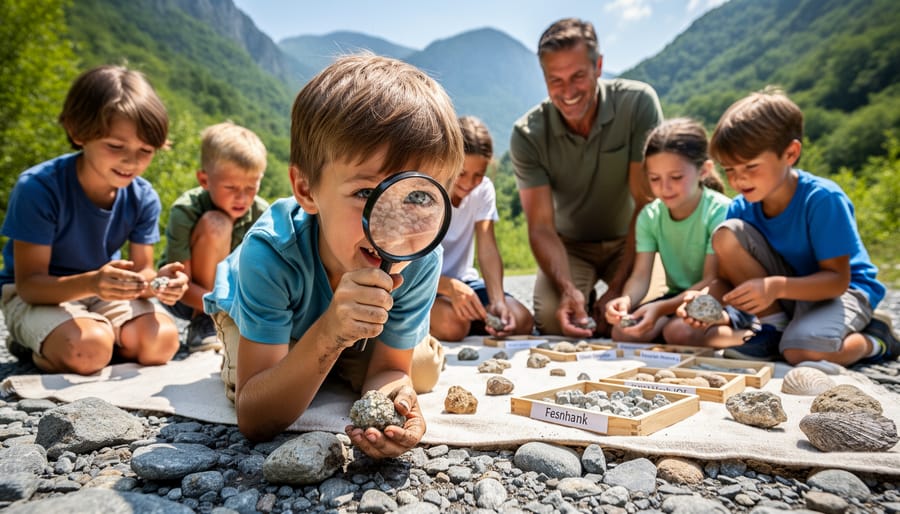
Turning geological exploration into a family adventure is easier than you might think—and it starts with reframing the experience as a quest rather than a lesson. Kids naturally love collecting things, so hand them a small bucket or bag and challenge them to find “rock treasures” in different colours: white quartz, pink granite, dark basalt. You’ll be amazed how quickly they become engaged geologists.
Create a geological scavenger hunt before your park visit. Print simple cards with pictures of common rock types found in Ontario—granite, limestone, shale—and have children check them off as they discover each one. Add bonus challenges like “find a rock with sparkles” (mica) or “spot a stone with layers” (sedimentary rocks). This transforms wandering into purposeful exploration and keeps even restless youngsters focused.
Storytelling brings rocks to life in magical ways. Explain that the Canadian Shield rocks they’re touching are older than dinosaurs—over a billion years old—and watch their eyes widen. Turn glacial erratics into “traveller stones” that journeyed hundreds of kilometres on rivers of ice. Suddenly, that boulder becomes an ancient adventurer with stories to tell.
Combine geological exploration with treasure hunting adventures like geocaching, where hidden containers often nestle among fascinating rock formations. Many Ontario parks offer junior geologist programs with stamps or badges—tangible rewards that motivate young explorers.
Insider tip: bring along a magnifying glass and field guide simplified for children. Let them examine crystal structures and textures up close, fostering scientific curiosity without pressure. Pack wet wipes too—muddy hands are badges of honour but clean-up helps everyone enjoy the car ride home. Remember, the goal isn’t perfect identification but sparking wonder about the ancient landscape beneath our feet.
Seasonal Considerations for Rock Hounds
Timing your rock hounding adventures can make all the difference between finding treasure and missing out. I learned this the hard way during my first spring expedition when muddy trails turned my fossil hunt into a boot-sucking adventure!
Spring brings melting snow and rain, which actually helps expose fresh rock faces and washes away debris. This season is perfect for spotting newly revealed specimens, though you’ll want waterproof boots and patience for muddy conditions. Late April through May offers the sweet spot when trails dry out but erosion has done its magic.
Summer is prime time for most geological sites. Long daylight hours mean more exploration time, and dry conditions make accessing remote locations much easier. Just remember that popular spots get crowded on weekends, so aim for weekday visits or early mornings. Pack plenty of water and sun protection since rock outcrops offer little shade.
Fall is my favorite season for rock hounding. Cooler temperatures make hiking more comfortable, and autumn rains often expose new finds without creating the muddy chaos of spring. Plus, the reduced foliage makes spotting rock formations easier, and those gorgeous fall colors provide stunning photo backdrops for your discoveries.
Winter shouldn’t stop dedicated rock hounds. Snow cover can actually help you spot surface rocks more easily, and frozen ground makes accessing wet areas possible. Ice formations along cliff faces reveal geological layers beautifully. Just exercise extra caution on slippery surfaces and dress in layers. Some provincial parks close certain trails seasonally, so always check ahead before planning your winter expedition.
Beyond the Rocks: Connecting Geology to the Bigger Picture
When you start looking at Ontario’s rocks with fresh eyes, you’ll discover they’re not just geological curiosities—they’re the foundation of everything around you. The ancient bedrock beneath your feet shapes where rivers flow, determines which plants can grow, and creates the very landscapes that wildlife calls home.
Think about it: those billion-year-old granite formations in the Canadian Shield don’t just sit there looking impressive. They create shallow soils that support unique plant communities like blueberries and jack pines, which in turn provide food and shelter for everything from black bears to tiny woodland songbirds. The cracks and crevices in limestone cliffs become nesting sites for peregrine falcons, while the mineral-rich runoff from certain rock types influences water chemistry in ways that determine which fish species thrive.
Water tells an especially fascinating story. Geology dictates where springs emerge, how groundwater flows, and why some lakes are crystal-clear while others are tea-stained. When you’re exploring, notice how vegetation changes as you move from one rock type to another—it’s like reading nature’s blueprint.
For Indigenous peoples, these geological features hold profound cultural significance extending back thousands of years. Many rock formations are sacred sites, teaching places, or waypoints on traditional routes. The ochre used in rock paintings came from iron-rich deposits, connecting artistic expression directly to the land itself.
Here’s an insider tip: before visiting any site, learn about its Indigenous history and protocols. Many natural wonders have stories that predate geological explanations, and understanding both perspectives creates a richer, more meaningful exploration experience. Respect signs, stay on designated trails, and remember you’re walking through living ecosystems built on ancient stone.
Ontario’s ancient rocks aren’t locked away in museums or reserved for scientists with specialized equipment. They’re right here, waiting for you along hiking trails, beside pristine lakes, and in provincial parks across the province. Every time you step onto a rocky outcrop or run your fingers across a weathered stone surface, you’re connecting with billions of years of Earth’s history in the most direct way possible.
The beauty of geological exploration is that it requires no expensive gear or advanced degrees. Start simple: visit your nearest conservation area this weekend with curious eyes and an open mind. Bring the kids along and turn it into a treasure hunt for different rock types. Pack a sketchbook to document interesting patterns, or simply sit quietly on a Canadian Shield granite outcrop and imagine the volcanic forces that shaped it eons ago.
Remember, every geologist started as someone who simply picked up an interesting rock and wondered about its story. Ontario’s geological wonders are democratic and patient, revealing their secrets to anyone willing to look closely and ask questions. Whether you’re exploring the dramatic cliffs of the Niagara Escarpment or the smooth, ancient stones along a northern lakeshore, you’re participating in a timeless conversation between people and planet. Get outside, touch the rocks, and let Ontario’s geological heritage inspire your sense of wonder.






+ There are no comments
Add yours